
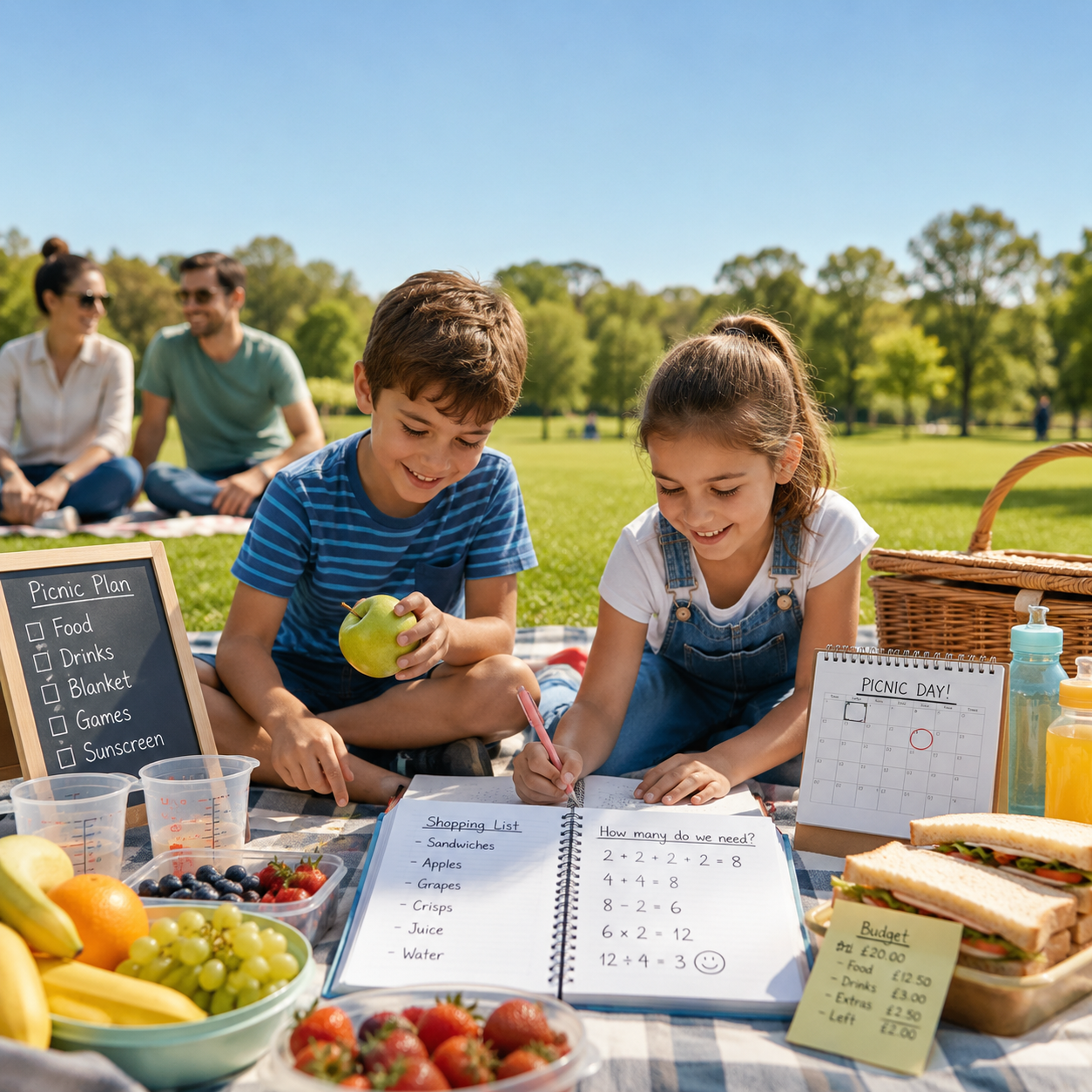
Planning a picnic may sound like a simple family activity. Pack some food, grab a blanket and head outside. However, when children are given responsibility for helping to organise the picnic, it quickly becomes much more than a day out.
Allowing children to plan a picnic gives them the chance to develop practical skills in a natural and enjoyable way. Instead of completing worksheets or formal activities, they learn through experience. Organisation, maths, problem-solving and communication all become part of the process without feeling like schoolwork.
Many parents look for ways to continue learning beyond the classroom, especially during weekends and school holidays. Everyday activities often provide some of the best opportunities for learning because children can immediately see why these skills matter.
Why practical learning matters
Children often struggle to understand why they need certain skills at school. It is common to hear questions such as, “When will I ever use this?”
Practical experiences answer that question.
When children use maths and organisation in real situations, learning feels purposeful. Rather than solving abstract problems, they can apply their thinking to something that has a clear outcome.
Planning a picnic gives children ownership and responsibility. It also helps them understand that many of the skills they learn in school appear in everyday life.
Real-world experiences can increase confidence too. Children can see the results of their own decisions, which often helps learning feel more rewarding.
How planning a picnic builds organisation skills
Organisation is not something children automatically learn overnight. It develops gradually and often improves through repeated opportunities to plan, prepare and think ahead.
Planning a picnic naturally encourages these habits because children need to consider several things at once. They begin thinking about what they need, what might happen and how they can make sure everything runs smoothly.
They may need to think about where the picnic will take place, who is coming and what needs to be packed. They might also need to consider practical questions around timings, transport and weather.
Parents can support this process by asking simple questions rather than giving instructions.
Asking, “What do we need to remember?” encourages children to think independently. Questions such as, “What happens if it rains?” or “How much food will everyone need?” help children begin planning ahead.
Children quickly discover that forgetting something can have consequences. Leaving drinks at home or forgetting plates may seem frustrating in the moment, but it also teaches valuable lessons about preparation and responsibility.
How planning a picnic teaches maths skills
Many parents feel uncertain about supporting maths at home, yet maths appears naturally in everyday situations.
A picnic creates countless opportunities for children to practise important mathematical skills without it feeling forced.
Children might start by counting how many people are attending. They may then calculate how many sandwiches, snacks or drinks are needed.
For younger children, simple counting can be enough. Asking how many apples are needed for four people allows them to practise basic number skills.
Older children can begin using multiplication and larger calculations. For example, if six people each want two sandwiches, they can work out how many sandwiches need to be prepared altogether.
Money becomes an important part of the process
Giving children a set budget for the picnic allows them to make decisions and think carefully about spending. They might compare prices in shops, estimate totals or work out how much change they should receive.
Budgeting teaches much more than simple calculations. It introduces decision making and prioritising too.
Children often realise that choosing one expensive item means having less money available for something else. Learning to balance choices is a valuable skill that extends well beyond mathematics.
Food preparation can also introduce mathematical ideas such as measuring and fractions.
Cutting sandwiches into halves or quarters and sharing food equally helps children understand concepts in a practical way. Rather than seeing fractions written on paper, they can physically see what those numbers represent.
Problem-solving becomes part of the experience
Things do not always go exactly as planned, and this creates useful learning opportunities.
The weather forecast might suddenly change. A favourite snack may be unavailable in the shop. Someone attending might have dietary requirements, or the budget might not stretch as far as expected.
Children have to think differently and adapt
Instead of seeing problems as something negative, they begin learning how to ask important questions.
What can we change? What can we do instead? Is there another solution?
These moments help children become flexible thinkers and improve their ability to deal with challenges.
Building independence and confidence
Children often enjoy being trusted with responsibility.
Even small tasks can help them feel involved and capable. Writing a shopping list, deciding on snacks or helping to pack bags gives children a sense of ownership.
As children successfully complete these tasks, confidence often grows.
Small achievements matter because they gradually shape how children see themselves. Children who regularly experience success are more likely to approach future challenges positively.
Confidence developed through everyday experiences can often carry over into school and other areas of life.
Planning a picnic with teenagers
Teenagers may not always seem enthusiastic about family activities, but practical responsibilities can still be highly engaging.
Older children can take on more complex planning tasks and make greater use of independent thinking.
Teenagers may enjoy researching picnic locations, comparing prices online or planning travel arrangements. They might calculate the total cost for several people or create a schedule for the day.
Technology can also become part of the process. Teenagers may choose to use budgeting apps, online maps or spreadsheets to organise plans.
As academic pressures increase through GCSEs and A-levels, organisation becomes increasingly important. Practical experiences like these can strengthen planning habits that later support revision, deadlines and independent study.
Planning a picnic for children with SEND
Children with special educational needs and disabilities can benefit greatly from practical learning opportunities, although activities may need adapting to suit individual needs.
Many children with SEND respond well to structure and visual support.
Breaking tasks into smaller stages can make activities feel less overwhelming. Visual shopping lists, picture schedules and clear routines can all help children understand expectations.
Some children may prefer being given choices rather than open-ended questions. Offering two snack options instead of asking broad questions can sometimes feel easier to process.
Children may also benefit from hands-on experiences such as packing bags, sorting items or preparing food.
There is no single approach that works for every child. The aim is not to create a perfect picnic plan. The focus should instead be on building confidence, encouraging participation and making the experience enjoyable.
Skills children learn through planning a picnic
Planning a picnic can help children develop:
- Organisation, maths skills, problem-solving, communication, budgeting, independence and confidence.
These are skills children continue using throughout education and later life.
Final thoughts
Planning a picnic is about far more than choosing food and finding somewhere sunny to sit.
When children are given responsibility, they begin learning important lessons naturally. They practise maths in meaningful situations, develop organisation skills and gain confidence in their own abilities.
Whether your child is in primary school, preparing for GCSEs or has additional learning needs, everyday experiences can create valuable learning opportunities.
Sometimes the simplest activities teach the biggest lessons.