
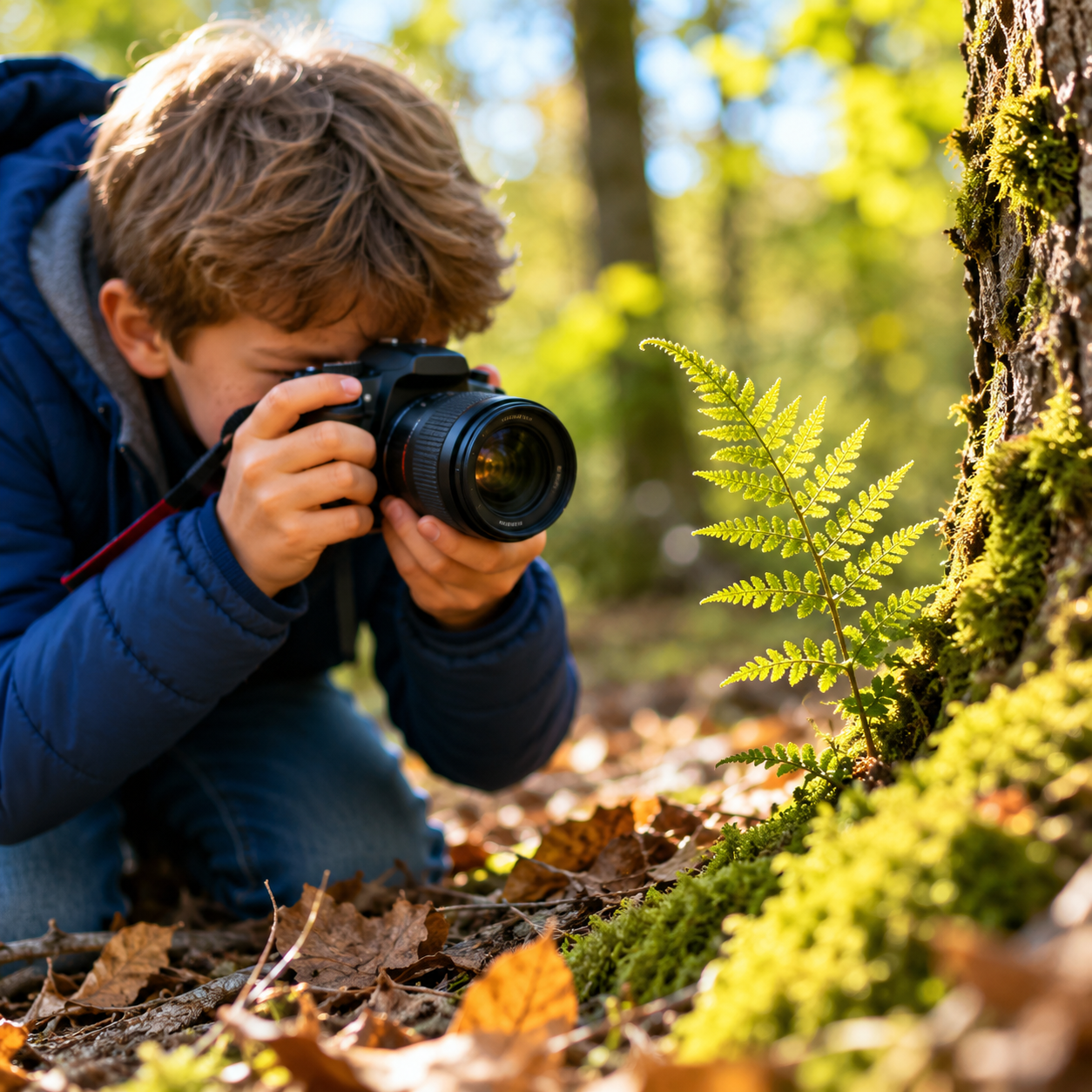
In a world filled with screens, notifications and fast-moving information, helping children slow down and pay attention can be increasingly challenging. Yet one simple activity can make a remarkable difference: nature photography.
Whether a child is using a smartphone, a tablet, a digital camera or even a disposable camera, taking photographs outdoors encourages them to look more carefully at the world around them. As they search for interesting subjects to photograph, children naturally begin noticing patterns, textures, shapes, colours and details that might otherwise go unnoticed.
Nature photography combines creativity, observation and science in a way that feels enjoyable rather than educational. It can be adapted for children of all ages and abilities, making it an accessible activity for families, schools and tutors alike.
In this article, we will explore how nature photography helps children develop attention to detail, recognise patterns, build learning skills and strengthen their connection with the natural world.
Why Observation Skills Matter
Observation is one of the most important foundations of learning. Before children can analyse, interpret or solve problems, they must first learn to notice information.
Strong observation skills support reading, comprehension, scientific investigation, mathematical reasoning, creative writing, emotional awareness and critical thinking. Children who learn to observe carefully often become more curious learners because they begin asking questions about the things they notice. They become better at spotting similarities and differences, identifying cause and effect, and making connections between ideas.
Nature photography provides an engaging way to practise these skills because it rewards careful attention. The more closely children look, the more interesting subjects they discover.
Learning to Slow Down
Many children move quickly through outdoor spaces. They may run through a park without noticing the different leaf shapes beneath their feet or walk past a flower without seeing the tiny insects resting on its petals.
Photography naturally encourages children to slow down. To capture a good image, they often need to stop, focus and look carefully. They may crouch down to examine a mushroom, zoom in on the veins of a leaf or wait patiently for a butterfly to land.
This slower pace encourages mindful observation and sustained concentration. In an age where children are often encouraged to consume information rapidly, learning to pause and pay attention is a valuable skill. These habits can support learning in the classroom too, helping children approach reading tasks, mathematical problems and scientific investigations with greater care.
Spotting Patterns in Nature
Nature is full of patterns, and photography helps children discover them.
As children take photographs, they begin noticing repeating shapes in flower petals, spirals in shells, symmetrical butterfly wings and branching patterns in trees. They may observe that leaves often follow similar structures or that certain flowers display remarkable symmetry.
Recognising these patterns helps children understand that mathematics exists beyond the classroom. Concepts such as symmetry, repetition, sequencing and geometry suddenly become visible in the world around them.
A child who photographs several different flowers may begin comparing the number and arrangement of petals. Another might notice repeating patterns in tree bark or the way seeds are arranged within a sunflower. These observations help make abstract concepts more concrete and meaningful.
Encouraging Scientific Thinking
Nature photography also supports scientific learning because it encourages children to become investigators.
Scientists begin by observing carefully, collecting evidence and asking questions. Photography mirrors this process. Children may photograph the same tree across different seasons and document changes over time. Others might compare leaves from different species or create a collection of photographs showing local wildlife.
Looking back through these images encourages reflection and analysis. Children often begin asking questions about why certain changes occur, why some plants grow in particular locations or how animals adapt to their environments.
The camera becomes more than a creative tool. It becomes a way of recording evidence and exploring ideas, helping children develop scientific curiosity in a natural and enjoyable way.
Supporting Creativity and Imagination
Nature photography is equally valuable for creative development.
Every photograph involves a series of choices. Children decide what to photograph, which angle to use and what details deserve attention. Two children standing in exactly the same place may produce completely different photographs because they notice different things.
This freedom encourages creative thinking and self-expression. Children begin experimenting with perspective, light and composition without necessarily realising they are developing artistic skills.
The photographs they take can also become springboards for other creative activities. A close-up image of a spider’s web might inspire a poem. A photograph of an unusual tree could spark a story about a magical forest. A collection of wildlife images may lead to a homemade nature journal.
Developing Language and Communication Skills
The process of observing and describing photographs can have a significant impact on language development.
Children often need increasingly precise vocabulary to explain what they have captured. Instead of describing a leaf simply as green, they may begin talking about its texture, shape, pattern and colour variations. They might describe it as glossy, jagged, delicate, speckled or veined.
These richer descriptions strengthen both spoken and written language. For reluctant writers, photographs can provide useful prompts that make writing tasks feel less intimidating. Rather than facing a blank page, children can focus on describing something they have personally observed and photographed.
Nature Photography for Different Ages
The way children engage with nature photography will naturally evolve as they grow older.
Young children often enjoy simple exploration. They may delight in photographing colourful flowers, unusual stones or tiny insects. At this stage, the emphasis should be on curiosity and discovery rather than technical quality.
Primary-aged children often enjoy giving themselves challenges. They might spend a walk searching for examples of symmetry, different textures or signs of seasonal change. These activities help develop observation and classification skills while maintaining a sense of fun.
Older children and teenagers may enjoy more complex projects. They might document wildlife habitats, investigate environmental changes, experiment with macro photography or create themed collections of images. Photography can become a valuable tool for supporting GCSE subjects such as science, geography, art and English, where detailed observation and analysis are essential skills.
Practical Home Learning Tips for Parents
Parents do not need specialist equipment or photography knowledge to use nature photography as a learning tool. In most cases, a smartphone camera is more than sufficient.
One of the simplest approaches is to turn a family walk into a photography challenge. Encourage your child to photograph five different patterns they can find in nature or ask them to capture examples of different textures. When you return home, spend time discussing the images together and ask questions about what they noticed that they might otherwise have missed.
Creating a seasonal photography journal can also be highly effective. Encourage your child to photograph the same tree, plant or outdoor space every few weeks throughout the year. Comparing the images helps children understand seasonal changes while developing observation skills.
Another useful activity is to print selected photographs and use them as prompts for writing, storytelling or research projects. Children can label features, write descriptive paragraphs or investigate the plants and animals they have photographed.
Most importantly, focus on curiosity rather than perfection. Praise your child’s observations and discoveries rather than the technical quality of the photographs. The real learning comes from looking carefully, asking questions and noticing details.
Nature Photography and SEND Learners
Nature photography can be particularly valuable for children with SEND because it offers a flexible and highly personalised learning experience.
Many children with autism enjoy the opportunity to focus on specific interests and notice fine details that others may overlook. Photography provides a structured way to explore these interests while building confidence and communication skills.
For children with ADHD, photography combines movement, exploration and active engagement. Rather than sitting still for extended periods, children can learn through doing while still developing concentration and sustained attention. The process of searching for interesting subjects often feels more motivating than traditional learning activities.
Children with anxiety may benefit from the calming effects of spending time outdoors and focusing their attention on the present moment. Looking for details in nature can help reduce feelings of overwhelm while providing a positive sense of achievement.
Photography can also support children with speech, language or communication needs. Images provide a concrete starting point for discussion, making it easier for some children to express their thoughts and observations.
The adaptable nature of photography means activities can be tailored to individual strengths, interests and sensory preferences, making it an inclusive learning tool for a wide range of learners.
Helping Children Develop Lifelong Curiosity
Nature photography is about far more than taking pictures.
It encourages children to slow down, pay attention and appreciate the details that often go unnoticed. In doing so, it strengthens observation, concentration, creativity, communication and scientific thinking.
The ability to notice patterns and detail supports learning across many subjects and helps children become more thoughtful, curious and reflective individuals. It teaches them that there is always something new to discover if they take the time to look closely.
Whether they are photographing flowers in a garden, leaves in a local park or wildlife on a family walk, children are developing habits of observation that can benefit them throughout their education and beyond.
In a fast-paced world, nature photography offers something increasingly valuable: the chance to pause, look carefully and truly notice the remarkable details that surround us every day.