
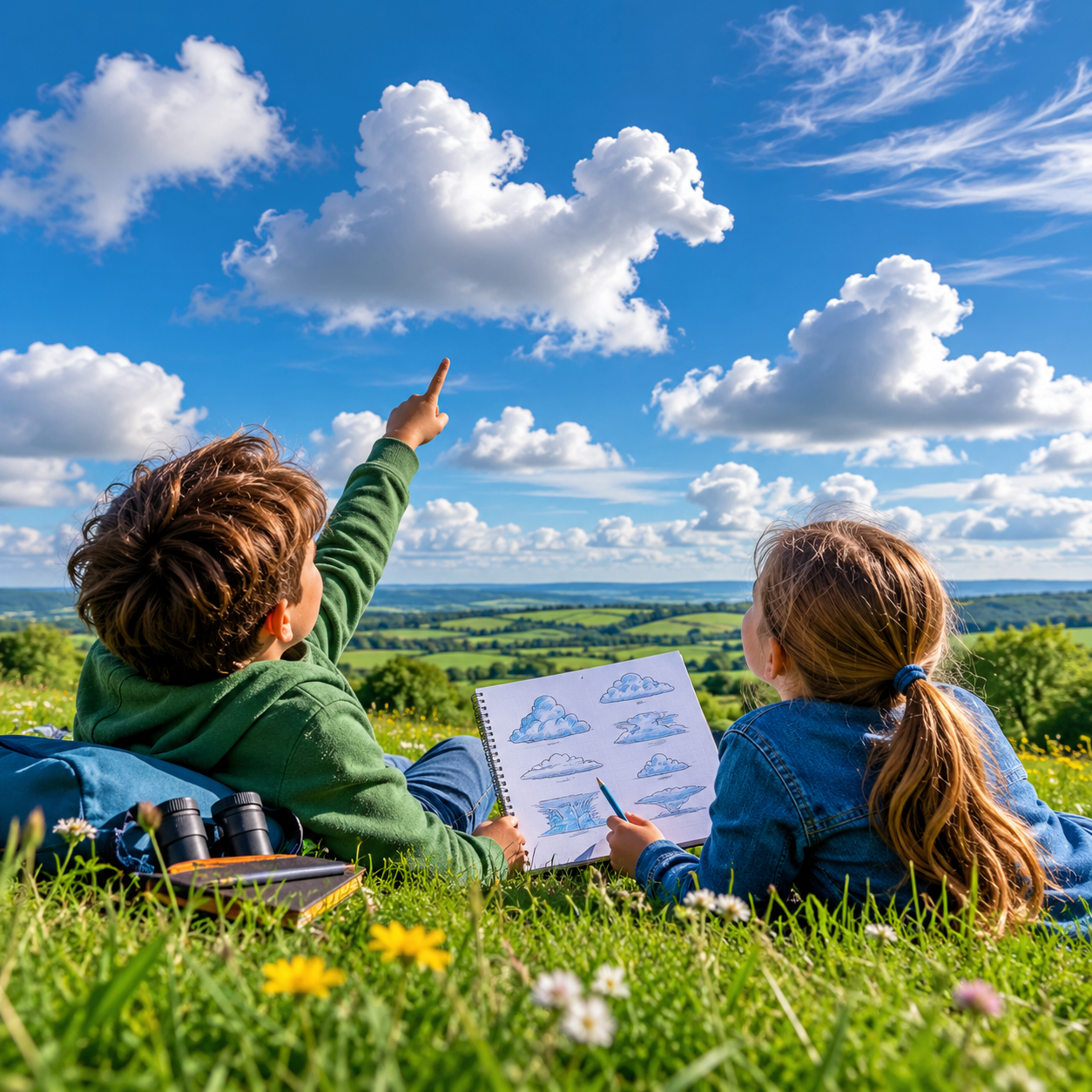
Cloud spotting might seem like a simple pastime, but it can be one of the most engaging and educational geography activities for children. Whether you are lying in the garden on a sunny afternoon, looking out of a classroom window, or taking a walk through the local park, the sky offers a constantly changing geography lesson that is completely free and available almost anywhere.
For children, geography is about much more than learning the names of countries and capital cities. It is about understanding the world around them, recognising patterns in nature, and developing curiosity about how environments work. Cloud spotting helps children do exactly that. It encourages observation, critical thinking, scientific enquiry, and a deeper understanding of weather systems and the natural environment.
In a world where many children spend significant amounts of time indoors or using digital devices, cloud spotting offers a valuable opportunity to slow down, look up, and engage with the real world. It can be adapted for different ages and abilities, making it suitable for young children, older learners, and many pupils with SEND.
In this article, we will explore why cloud spotting is such a brilliant geography activity for children, what skills it develops, how it supports learning across different age groups, and how parents and educators can make the most of this simple but powerful learning opportunity.
What Is Cloud Spotting?
Cloud spotting involves observing clouds and identifying different cloud types, shapes, movements, and patterns. While many people associate cloud watching with imagining shapes and animals in the sky, cloud spotting takes things a step further by encouraging children to learn about how clouds form and what they can tell us about weather conditions.
Children can learn to recognise different cloud formations such as cumulus, stratus, cirrus, and cumulonimbus clouds. They can begin to understand how clouds are linked to temperature, moisture, wind, and weather changes.
What makes cloud spotting particularly valuable is that it turns the sky into a living classroom. Every day brings something slightly different, encouraging children to develop observational skills and ask questions about what they see.
How Cloud Spotting Supports Geography Learning
Geography is fundamentally about understanding the relationships between people, places, and environments. Weather and climate are key parts of the geography curriculum, and cloud spotting provides a practical way for children to engage with these concepts.
Rather than learning solely from textbooks or videos, children can observe real-world examples of geographical processes in action. They begin to see how weather systems influence everyday life and how the atmosphere constantly changes.
Cloud spotting helps children understand:
- Different types of clouds and how they form
- Basic weather patterns and forecasting
- The water cycle
- Atmospheric conditions
- Climate and seasonal changes
- Environmental observation skills
- The relationship between weather and human activities
These concepts often become much easier to understand when children can directly observe them rather than simply reading about them.
Building Observation Skills
One of the greatest educational benefits of cloud spotting is the way it develops observation skills.
Modern life often encourages children to move quickly from one activity to the next. Cloud spotting requires something different. It encourages them to pause, focus, and pay attention to subtle details.
Children learn to notice:
- The colour of clouds
- Their shape and structure
- Their movement across the sky
- Changes over time
- Differences between weather conditions
These observation skills transfer into many other areas of learning. Children who learn to notice details in nature often become stronger scientists, geographers, artists, and problem-solvers.
Observation is a foundational skill that supports success across the curriculum.
Encouraging Curiosity and Questioning
Great geography begins with curiosity.
When children spend time observing clouds, they naturally begin asking questions:
Why do some clouds look fluffy while others appear thin and wispy?
Why are clouds moving in different directions?
Why do dark clouds often bring rain?
Why are there more clouds on some days than others?
These questions create opportunities for meaningful learning. Instead of simply providing answers, parents and educators can encourage children to investigate, research, and test their ideas.
This inquiry-based approach helps children develop a deeper understanding of geographical concepts while strengthening their confidence as learners.
Understanding the Water Cycle
The water cycle can sometimes feel abstract for younger children. Cloud spotting makes it much more concrete.
Children can see evidence of evaporation, condensation, and precipitation taking place around them. As they learn how clouds form from water vapour and eventually release rain, the stages of the water cycle become easier to understand.
By regularly observing the sky, children can start making connections between what they learn in school and what they see in everyday life.
For example, after a rainy day, they may begin noticing how puddles disappear as water evaporates. They can then connect this process to cloud formation and future rainfall.
This real-world learning often leads to stronger understanding and retention.
Developing Weather Awareness
Cloud spotting naturally helps children become more aware of weather conditions.
Over time, they begin recognising patterns. They may notice that certain clouds often appear before rain or that clear skies tend to accompany particular weather conditions.
This introduces basic forecasting skills and helps children understand that weather is not random. Instead, it follows patterns that can be observed and interpreted.
Understanding weather can also help children appreciate how weather affects agriculture, transport, recreation, and daily life. These are important geographical themes that become increasingly relevant as children progress through school.
Supporting Different Age Groups
One reason cloud spotting works so well as a learning activity is its flexibility.
Early Years and Key Stage 1
Young children can focus on simple observation and imagination.
They might describe cloud shapes, colours, and movements. Adults can introduce basic vocabulary while encouraging children to share what they notice.
At this age, the emphasis should remain playful and exploratory.
Key Stage 2
Primary-aged children can begin identifying different cloud types and learning about weather patterns.
They may enjoy keeping a cloud diary, drawing cloud formations, or recording observations over several weeks.
These activities help build scientific and geographical thinking while remaining engaging and accessible.
Secondary School Students
Older learners can explore more complex concepts such as atmospheric processes, climate systems, and meteorology.
They can investigate how clouds form at different altitudes, how pressure systems influence weather, and how climate varies across different regions.
Cloud spotting can become a valuable supplement to more advanced geography studies.
Cloud Spotting for Children with SEND
Cloud spotting can be particularly beneficial for many children with SEND.
The activity is naturally adaptable and can be adjusted to suit different needs, interests, and learning styles.
Many children benefit from outdoor learning experiences that reduce pressure and provide opportunities for sensory engagement. Watching clouds can create a calm and structured environment where learning feels less formal and more enjoyable.
For autistic learners, cloud spotting can offer predictable routines and opportunities to focus on specific interests. Some children may enjoy categorising cloud types or recording observations systematically.
Children with ADHD may benefit from the combination of movement and observation. Rather than sitting at a desk, they can engage with learning in an active outdoor setting.
Children with anxiety may find cloud spotting relaxing and grounding. Looking at the sky can encourage mindfulness and help reduce stress while still supporting educational goals.
For learners with literacy difficulties, cloud observations can be recorded through drawings, photographs, voice recordings, or simple symbols rather than extensive writing.
The flexibility of cloud spotting allows educators and parents to tailor the activity to individual strengths and needs.
Supporting Cross-Curricular Learning
Although cloud spotting is an excellent geography activity, it also supports learning across many other subjects.
Science links are particularly obvious, as children learn about weather, states of matter, and atmospheric processes.
English skills can be developed through descriptive writing, storytelling, and discussion.
Mathematics can be incorporated through measuring temperature, recording observations, tracking weather patterns, and creating charts.
Art opportunities arise through sketching clouds, painting skies, and exploring colour and texture.
This cross-curricular nature makes cloud spotting a highly efficient educational activity that supports multiple areas of development simultaneously.
Encouraging Outdoor Learning
Outdoor learning has become increasingly recognised as an important part of children’s education.
Spending time outdoors can improve wellbeing, concentration, and engagement. It provides opportunities for experiential learning that are difficult to replicate indoors.
Cloud spotting requires very little equipment. In most cases, all children need is a safe outdoor space and a willingness to observe.
This accessibility makes it ideal for families, schools, tutors, and home educators.
Even children who live in cities or flats can participate. A balcony, local park, playground, or simply looking out of a window can provide plenty of opportunities for cloud observation.
Practical Tips for Parents
Parents do not need specialist knowledge to make cloud spotting educational.
Simply encouraging children to observe and discuss what they see can create valuable learning opportunities.
You might ask questions such as:
“What do you notice about those clouds?”
“Do you think the weather might change later?”
“How are today’s clouds different from yesterday’s?”
“What shapes can you see?”
Keeping a simple cloud journal can also help children track observations and notice patterns over time.
Many free cloud identification guides are available online, allowing families to gradually build their knowledge together.
The key is not to turn cloud spotting into a formal lesson. Maintaining a sense of curiosity and discovery often leads to the most meaningful learning experiences.
Why Simple Activities Often Have the Greatest Impact
Many parents feel pressure to provide expensive educational experiences or highly structured activities. However, some of the most powerful learning opportunities are remarkably simple.
Cloud spotting costs nothing, requires minimal preparation, and can be enjoyed almost anywhere.
Yet within this simple activity, children develop observation skills, scientific understanding, geographical knowledge, curiosity, critical thinking, and environmental awareness.
They learn to engage with the world around them rather than simply consuming information about it.
These experiences help children build a deeper connection with nature while developing skills that support lifelong learning.
Final Thoughts
Cloud spotting may appear to be a quiet and uncomplicated activity, but its educational value should not be underestimated. It transforms everyday moments into opportunities for meaningful geography learning and helps children understand the natural processes shaping the world around them.
Whether your child is in the early years, preparing for secondary school, learning at home, or accessing support through a SEND provision, cloud spotting can offer an engaging and accessible way to explore geography.
By encouraging children to look up, observe carefully, and ask questions about what they see, we help them develop curiosity, confidence, and a greater understanding of the environment. Sometimes the best classroom is not inside a building at all—it is simply the sky above us.