
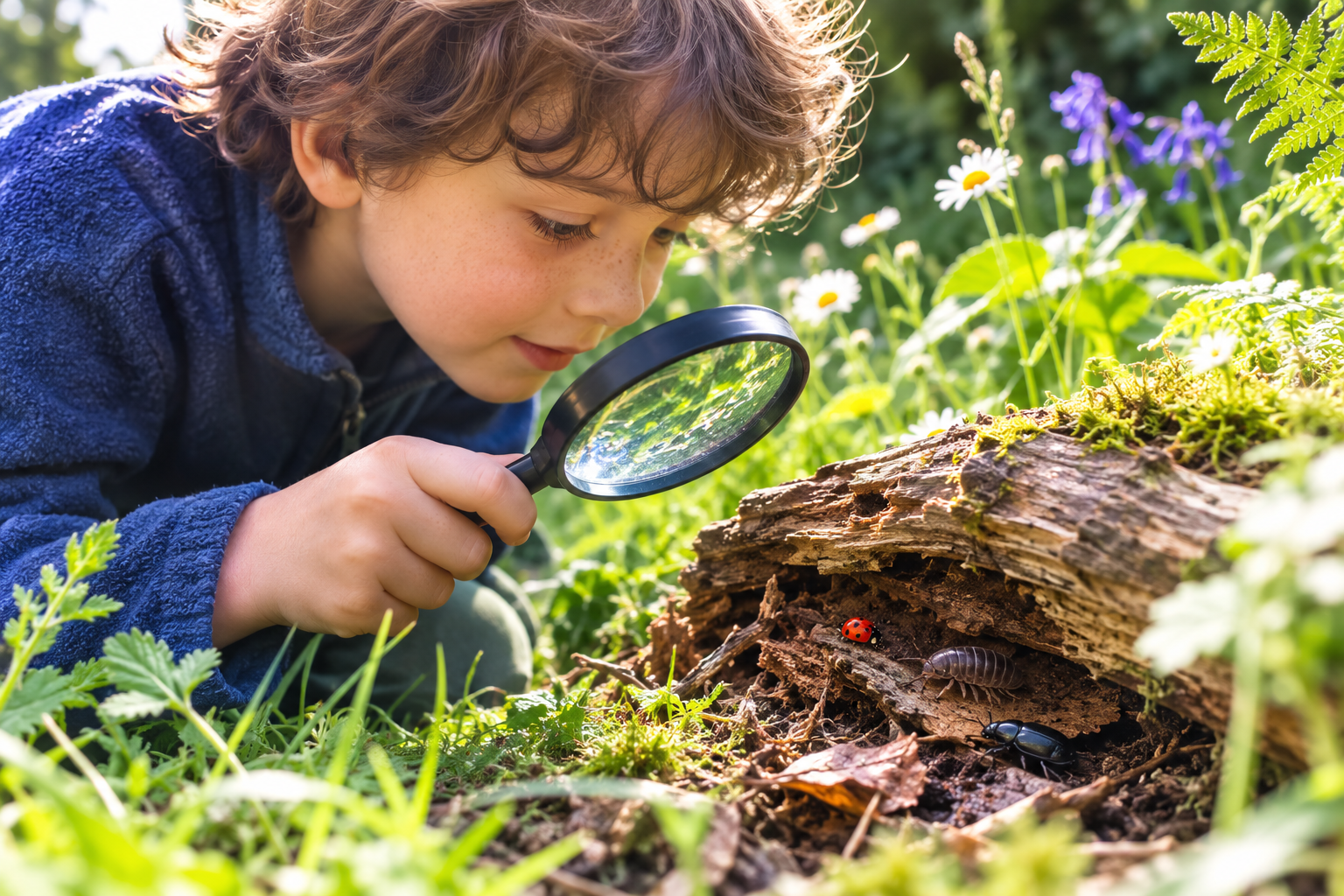
Children are naturally curious about the world around them. Give them a magnifying glass, a patch of grass and a few minutes outside, and they are often completely absorbed in searching for tiny creatures hiding beneath leaves, logs and stones. What seems like a simple bug hunt is actually a fantastic opportunity to introduce children to the fascinating world of ecosystems.
Learning about ecosystems does not have to begin with textbooks or complicated scientific diagrams. Some of the best lessons happen through first-hand experiences, where children observe, question and discover for themselves. A bug hunt encourages children to slow down, notice details and appreciate how every living thing plays an important role in nature. Along the way, they develop scientific thinking, environmental awareness and a wide range of transferable skills that support learning across the curriculum.
Whether you have access to a garden, local park, woodland, school field or even a few plant pots on a balcony, exploring mini habitats can become an engaging educational activity suitable for children of many different ages. Better still, it costs very little to organise and can easily become a regular family activity throughout the year.
What is an ecosystem?
An ecosystem is a community of living things, including plants, animals, fungi and microorganisms, interacting with one another and with their physical environment. Every ecosystem, whether it is a rainforest, pond, woodland or a patch of grass at the local park, relies on balance. Each living thing has a role that helps the whole environment function.
For younger children, this concept can be introduced very simply by explaining that every plant and creature needs food, water, shelter and space to survive. Older children can begin exploring more advanced ideas such as biodiversity, food webs, adaptation, conservation and environmental change. Seeing these ideas in real life makes them much easier to understand than simply reading about them.
Why bug hunts are such powerful learning experiences
Children remember experiences far better than facts they have only read or heard. Instead of memorising that woodlice like damp environments, they discover this themselves by lifting a log. Rather than reading that bees pollinate flowers, they watch one collecting nectar from blossom before flying to another plant.
These real-life observations help children build deeper understanding because they are actively involved in the learning process. They naturally begin asking questions, spotting patterns and making connections between different living things. This curiosity forms the foundation of scientific enquiry and encourages children to think critically about the natural world.
Bug hunts also promote patience and mindfulness. Children slow down, concentrate on tiny details and become fully engaged in what they are doing. These skills support learning well beyond science lessons.
Discovering different habitats
One of the first things children notice during a bug hunt is that different creatures choose different places to live. Earthworms appear in damp soil, ladybirds are often found on leaves, ants create trails across paths, while spiders build webs between plants and fences.
As children compare these locations, they begin to understand that every species has particular needs. Some require shade, others need moisture, while many depend on specific plants for food or shelter. This naturally introduces the concept of habitats and adaptation.
Parents can encourage this learning by asking simple questions rather than providing all the answers. Asking, “Why do you think the worms are here instead of over there?” or “What do all these insects have in common?” encourages children to think like young scientists.
Learning that every creature has a purpose
Many children initially think of insects simply as creepy crawlies or pests. A bug hunt helps change this perception by showing that every creature has an important job within its ecosystem.
Earthworms improve soil by breaking down organic matter and allowing air and water to reach plant roots. Bees pollinate flowers that later produce fruit and seeds. Ladybirds help control aphid populations that would otherwise damage plants. Woodlice recycle dead leaves, while spiders help keep insect numbers balanced.
Once children understand these roles, they begin to appreciate that even the smallest creatures contribute to the health of the environment. This understanding often develops into greater respect for wildlife and a stronger interest in protecting nature.
Introducing food chains and food webs
Bug hunts provide excellent opportunities to explain food chains in ways children can actually observe. They may notice caterpillars eating leaves, birds searching for insects or spiders catching flies in their webs. These simple observations demonstrate that living things depend upon one another for survival.
As children become older, these ideas can be expanded into food webs, showing that ecosystems are made up of many interconnected relationships rather than simple chains. They can begin discussing what might happen if one species disappeared and how this could affect many others.
Parents can continue these conversations at home by looking up unfamiliar insects together and discussing where they fit within the local ecosystem.
Developing observation and scientific enquiry skills
Science is built upon careful observation, and bug hunts provide endless opportunities to practise this skill.
Children naturally compare colours, body shapes, movement, habitats, sizes and behaviour. They begin looking more carefully, noticing tiny details that they may previously have overlooked. Recording observations through sketches, photographs or simple notes helps reinforce what they have learned while introducing basic scientific recording techniques.
Parents do not need specialist knowledge to support this process. Simply encouraging children to describe what they can see before naming the insect helps strengthen observation skills. Asking children to explain how they know two insects are different often produces thoughtful discussions that develop scientific vocabulary.
Understanding biodiversity
One of the most valuable lessons children gain from bug hunts is an appreciation of biodiversity. Even the smallest patch of grass contains an incredible variety of living organisms, each contributing to the ecosystem in different ways.
Children soon discover that healthy environments contain many different species living together. They also begin noticing that different places contain different combinations of insects depending on factors such as sunlight, moisture and available plants.
These observations help children understand why protecting habitats matters and why reducing biodiversity can affect the balance of ecosystems.
Building respect for the natural world
Handling insects carefully teaches empathy and responsibility. Children learn that living creatures should be observed gently before being returned to exactly where they were found.
Parents can model respectful behaviour by replacing logs and stones carefully, avoiding damage to plants and reminding children that insects’ homes should be left as they were found. These simple habits encourage children to become responsible caretakers of the natural environment rather than simply observers.
This respect often extends beyond insects, encouraging children to value wildlife more generally and develop positive environmental attitudes that can last throughout their lives.
How bug hunts support the National Curriculum
One of the reasons bug hunts are so valuable is that they reinforce many areas of the National Curriculum in enjoyable and memorable ways.
During the Early Years Foundation Stage, children are encouraged to explore the natural world, notice similarities and differences and ask questions about living things. A simple bug hunt directly supports these early learning goals by encouraging observation and curiosity.
In Key Stage 1, children learn about identifying common animals, understanding habitats and recognising that different living things live in different environments. Searching for insects and discussing where they are found provides practical experience that brings these topics to life.
During Lower Key Stage 2, children begin learning about living things and their habitats, food chains and environmental changes. A bug hunt offers countless opportunities to observe these concepts in action rather than simply reading about them.
By Upper Key Stage 2, pupils investigate classification, adaptation, life cycles and more complex ecosystems. Older children can identify species using field guides, compare habitats, collect data and discuss biodiversity. These activities also strengthen working scientific skills by encouraging prediction, observation, recording and evaluation.
As children move into secondary school, their understanding develops further into ecology, environmental sustainability and conservation. The curiosity developed through simple childhood bug hunts provides a strong foundation for these more advanced scientific topics.
Practical ways parents can extend the learning
A bug hunt does not have to end once children return indoors. Parents can help consolidate learning through everyday conversations and simple follow-up activities that require very little preparation.
Encourage children to draw the insects they found and label their body parts. Ask them to write a short diary entry from the perspective of a ladybird or earthworm. Compare insects found in different seasons or after different weather conditions. Visit the same location every few weeks to see what has changed. Borrow children’s nature books from the local library or use trusted wildlife identification websites to learn together.
These simple extensions develop literacy, scientific understanding and observational skills while reinforcing the idea that learning happens everywhere, not only in classrooms.
Supporting children with SEND
Bug hunts can be particularly beneficial for children with SEND because they provide flexible, multisensory learning opportunities that can easily be adapted to individual strengths and needs.
Children with autism may enjoy the routine of searching and recording findings, while those with ADHD often benefit from active, movement-based learning that keeps them engaged. Children with dyslexia frequently find that practical experiences make scientific vocabulary more meaningful because words become attached to memorable experiences rather than isolated definitions.
Parents should feel comfortable adapting the activity to suit their child. Some children may prefer taking photographs instead of touching insects, while others may benefit from visual identification sheets, shorter exploration times or quiet outdoor spaces with fewer distractions. Allowing children to learn at their own pace often leads to greater confidence and enjoyment.
Creating lifelong learners through nature
Perhaps the greatest benefit of a simple bug hunt is that it nurtures curiosity. Children begin asking questions that do not always have immediate answers, and this willingness to explore, investigate and discover lies at the heart of lifelong learning.
Instead of seeing insects as insignificant, children begin recognising that every living thing contributes to the wider ecosystem. They develop patience, observation, empathy and scientific thinking while gaining a deeper appreciation of the natural world around them.
For parents, bug hunts offer a wonderful reminder that meaningful learning does not require expensive equipment or carefully planned lessons. Sometimes the most valuable educational experiences begin by simply stepping outside together and taking the time to look a little closer.