
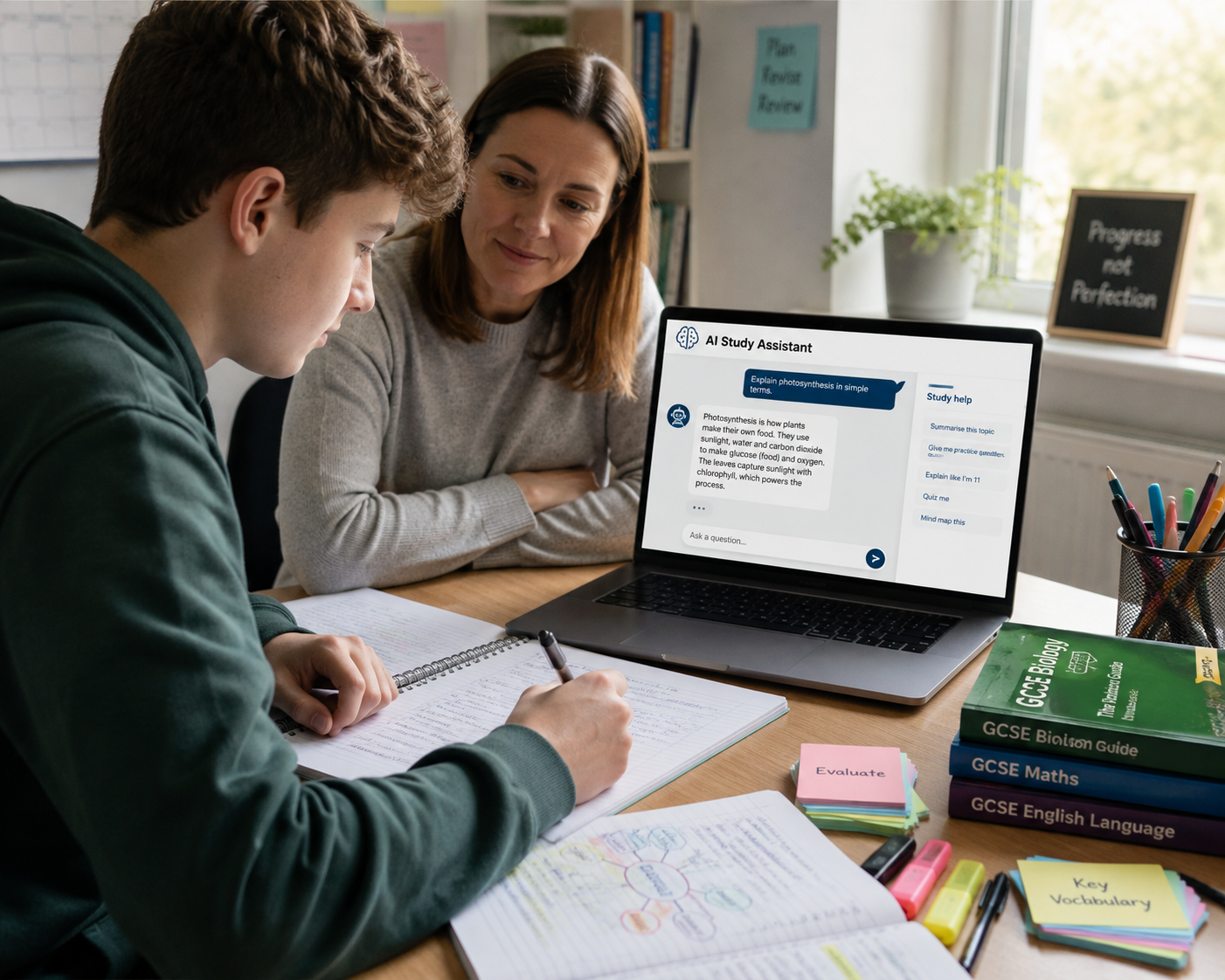
Artificial intelligence has rapidly become one of the biggest talking points in education. In just a few years, tools such as ChatGPT, Microsoft Copilot and Google Gemini have become widely available, giving students instant access to explanations, summaries, quizzes and even model answers. For many families, AI is now becoming as common as using a search engine.
This rapid growth naturally raises important questions. Is AI making homework easier, or is it making genuine learning harder? Can it improve revision, or does it encourage shortcuts? Should parents and teachers embrace it, restrict it or teach children how to use it responsibly?
The answer is rarely straightforward. Like calculators, search engines and spellcheck before it, AI is simply another tool. Used well, it can support learning, build confidence and provide personalised explanations. Used poorly, it can reduce independent thinking, create misconceptions and leave students less prepared for assessments.
Understanding both the strengths and the limitations of AI is becoming increasingly important for parents, teachers and students alike.
Why AI Has Become So Popular
One reason AI has spread so quickly is that it provides immediate help. Instead of searching through multiple websites or textbooks, students can ask questions in natural language and receive an instant response.
For example, rather than searching “photosynthesis explained Year 8”, a student can ask:
“Can you explain photosynthesis as if I am 12 years old?”
If they still do not understand, they can ask for another explanation, request diagrams, or ask for real-life examples.
This conversational style often feels much less intimidating than asking a teacher in front of the class or waiting until the next lesson.
AI also works at any time of day. If a student becomes stuck with homework at 8pm, they can ask questions immediately rather than waiting until school the following morning.
The Benefits of AI for Homework
When used appropriately, AI can become a valuable learning assistant rather than a replacement for learning.
Instead of simply giving answers, it can explain methods step by step, simplify difficult vocabulary and generate additional practice questions. This can be particularly useful for pupils who need concepts explained in different ways before they fully understand them.
Students often benefit from asking AI to:
- explain difficult concepts in simpler language
- generate extra practice questions
- test their knowledge with quizzes
- provide feedback on written work
- suggest revision timetables
- explain where they may have made mistakes in calculations or essays
These uses encourage active learning rather than passive copying.
Many students also find that AI reduces the anxiety of asking “basic” questions. Unlike a classroom, there is no embarrassment in asking for the same explanation several times.
How AI Can Improve Revision
Revision often becomes more effective when students actively retrieve information rather than simply rereading notes.
AI can support this process by generating flashcards, practice quizzes, mock exam questions and quick knowledge checks.
For example, a GCSE history student could ask for five practice questions about the Cold War before checking their answers against their own revision guide.
Similarly, a mathematics student can request increasingly difficult questions until they feel confident with a topic.
Because AI adapts to follow-up questions, revision sessions can become more personalised than using static revision materials alone.
The Risks of Over-Reliance
Despite its many strengths, AI has significant limitations that should not be ignored.
Perhaps the biggest danger is that students begin relying on AI to think instead of learning how to think themselves.
If every homework task is completed by asking AI for the answer, pupils may achieve completed assignments without developing genuine understanding.
This creates what teachers sometimes describe as the “illusion of learning“. Work looks complete, but the knowledge has never truly been learned.
This problem often becomes obvious during classroom assessments or examinations where AI is unavailable.
Students who have copied explanations rather than understanding them frequently struggle to apply knowledge independently.
AI Does Not Always Get Things Right
One of the biggest misconceptions is that AI is always accurate.
In reality, AI systems occasionally produce incorrect information while presenting it very confidently. These mistakes are sometimes called “hallucinations”.
An explanation may sound convincing but still contain factual errors, incorrect dates, inaccurate calculations or invented references.
This means students should never assume that an AI-generated answer is automatically correct.
Instead, they should develop the habit of checking important information against trusted sources such as school textbooks, teacher guidance, examination board specifications and reliable educational websites.
Critical thinking remains just as important as ever.
Homework Still Has an Important Purpose
Homework is not simply about producing correct answers.
Teachers often set homework so pupils can practise independent thinking, make mistakes safely and identify gaps in their understanding.
If AI completes every difficult part of the task, teachers lose valuable information about what students genuinely know.
Parents may also receive an unrealistic picture of their child’s progress.
Using AI to explain a concept is very different from asking it to complete the entire assignment.
The first supports learning.
The second often replaces it.
The Role of Parents
Many parents are unsure how much AI use should be allowed.
Rather than banning it completely, many experts suggest teaching children how to use it responsibly.
Parents might encourage children to:
Ask AI to explain ideas rather than provide completed answers.
Compare AI explanations with school notes.
Discuss answers together and ask children to explain concepts in their own words.
Use AI after attempting questions independently.
Treat AI as a tutor rather than a shortcut.
These habits help ensure technology supports genuine understanding instead of replacing it.
What Teachers Can Do
Schools across the UK are continuing to develop their own approaches to AI.
Many are now teaching pupils about responsible AI use alongside digital literacy.
Teachers can help by discussing when AI is appropriate and when independent work is expected.
Some homework tasks may actively encourage AI for brainstorming or feedback, while others may require pupils to complete work without AI support.
Clear expectations reduce confusion for both students and parents.
AI Is Not a Replacement for Good Revision Resources
Although AI can be extremely useful, it should never become the only revision resource a student relies upon.
Traditional revision guides continue to offer major advantages. Publications such as CGP revision guides are carefully written by subject specialists, closely matched to UK examination specifications and thoroughly checked for accuracy before publication.
Likewise, school textbooks, class notes and official exam board materials remain some of the most reliable resources available because they are specifically designed around curriculum requirements.
Perhaps most importantly, students should not underestimate the value of asking real people for help.
Teachers understand the misconceptions that commonly arise within their subjects and can adapt explanations accordingly. Personal tutors can identify gaps in understanding, provide tailored support and adjust their teaching based on how a student learns best. They can also ask probing questions, encourage deeper thinking and offer encouragement in ways that AI cannot genuinely replicate.
In many cases, the strongest revision combines several different resources. A student might revise from a CGP guide, complete past papers, ask their teacher about difficult topics, receive additional support from a tutor and then use AI to generate extra practice questions or alternative explanations. Each resource complements the others rather than replacing them.
AI and SEND Learners
AI may offer particular benefits for some children with Special Educational Needs and Disabilities (SEND).
Students with dyslexia, for example, may benefit from simplified explanations or help organising written ideas.
Pupils with ADHD may appreciate breaking revision into smaller chunks, generating short quizzes or creating structured revision plans.
Children with autism may value consistent explanations and opportunities to revisit concepts repeatedly without feeling judged.
However, the same cautions still apply.
Children with SEND often benefit greatly from skilled human support that recognises their individual strengths, communication preferences and learning profiles.
An experienced teacher or tutor can notice signs of frustration, adapt activities in real time and build trusting relationships that technology cannot replace.
AI should therefore be viewed as an additional support rather than a substitute for personalised teaching.
Safeguarding and Responsible AI Use
Alongside teaching children how to use AI effectively for learning, parents and teachers also need to discuss online safety. AI chatbots may feel conversational, but they are not trusted adults or appropriate sources of emotional support. Children should be reminded never to share personal information such as their full name, address, school, passwords, phone number or any other identifying details when using AI tools. They should also understand that if they are feeling worried, anxious, upset or unsafe, the right place to seek help is from trusted adults such as parents, carers, teachers or other members of their school’s pastoral team, not an AI chatbot. While AI can provide general information or suggest strategies for managing revision or study stress, it cannot understand an individual’s circumstances in the way that a caring adult can, nor can it provide safeguarding support or intervene if a child is at risk. Teaching young people to enjoy the educational benefits of AI while recognising its limitations is an increasingly important part of digital literacy and online safety.
What UK Research Is Saying
Research into AI in education is still developing, but UK organisations are increasingly investigating both its opportunities and its risks.
The Education Endowment Foundation (EEF) recently announced a major UK research programme worth up to £2.5 million to examine how generative AI affects children’s learning, cognition and educational outcomes. The organisation has recognised both the rapid growth in student AI use and the need for robust evidence before drawing firm conclusions. This balanced approach reflects the wider educational consensus: AI clearly has potential, but more research is needed to understand when it genuinely improves learning and when it may hinder it.
Looking Ahead
Artificial intelligence is unlikely to disappear from education. Instead, it will probably become another everyday learning tool alongside calculators, online videos and digital textbooks.
The real challenge is not deciding whether students should use AI at all.
It is helping them learn how to use it wisely.
Students who use AI to deepen understanding, test knowledge and explore ideas are likely to benefit far more than those who rely on it to complete work for them.
Parents and teachers have an important role in modelling this balanced approach.
By combining AI with trusted revision guides, high-quality teaching, independent thinking and regular practice, young people can enjoy the advantages of new technology without losing the essential skills that education is designed to develop.
Ultimately, successful learning has never depended on finding the fastest answer. It depends on curiosity, persistence, critical thinking and understanding. AI can support those qualities, but it cannot replace them.