
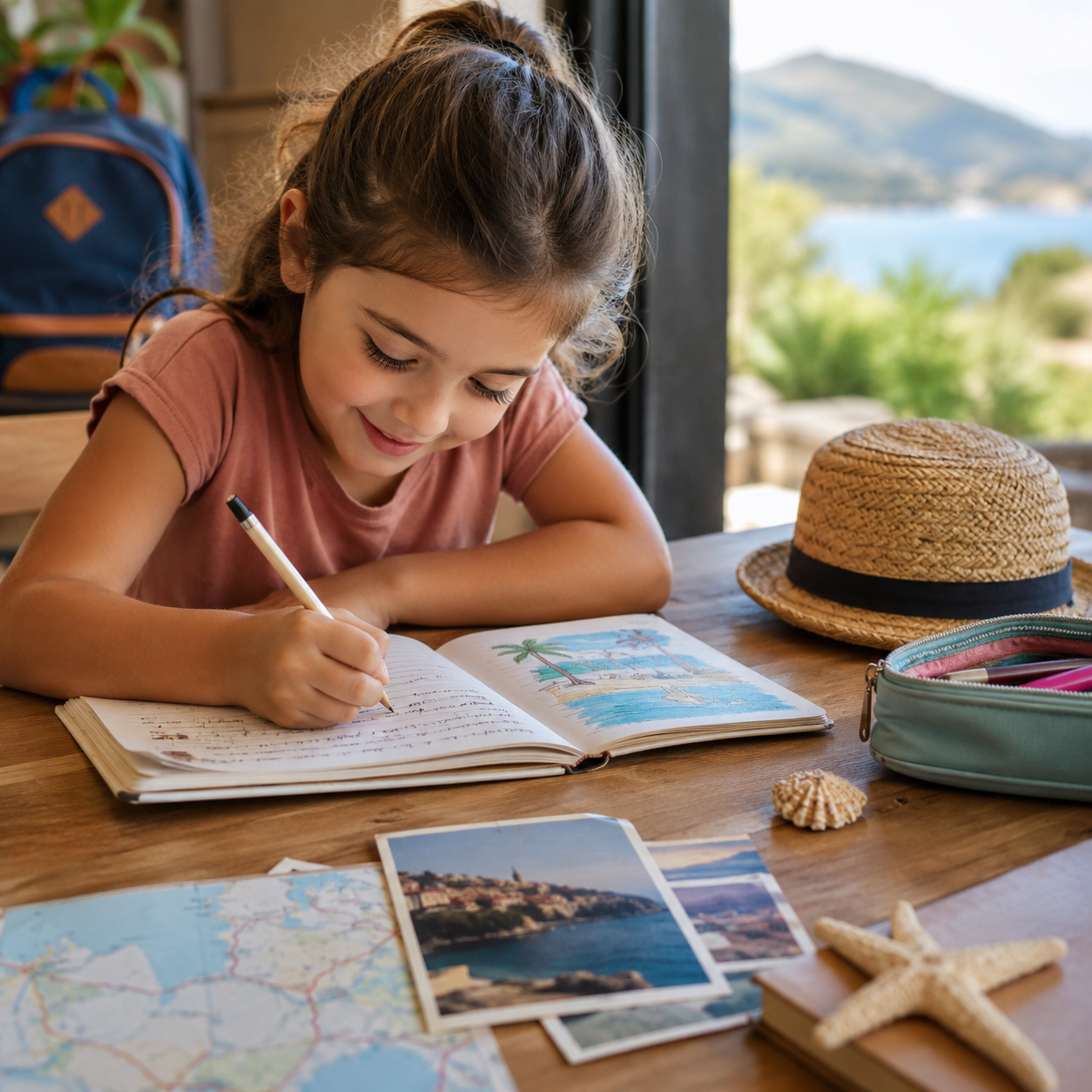
Many parents and carers worry that their child’s writing skills seem to slip during the school holidays. Without regular lessons, handwriting can become untidy, vocabulary may not be used as often and children can lose confidence when faced with a blank page. The good news is that maintaining writing skills does not have to involve formal worksheets or lengthy homework.
One of the simplest and most enjoyable ways to keep children writing is by encouraging them to keep a holiday journal. Whether they are travelling abroad, exploring their local area or enjoying time at home, recording their experiences can help children develop writing confidence while creating a lasting collection of memories.
The best part is that there is no right or wrong way to keep a journal. Some children enjoy writing several paragraphs, while others prefer short sentences, sketches, photographs or lists. By removing the pressure of perfect spelling or punctuation, children often become much more willing to put their thoughts onto paper.
Why writing confidence matters
Many children know what they want to say but hesitate when it comes to writing it down. They worry about making spelling mistakes, choosing the right words or getting their handwriting perfect. Over time, these worries can affect their confidence and make writing feel like a chore rather than an enjoyable way to communicate.
A holiday journal offers a completely different experience. Instead of writing to meet a school objective, children write because they want to remember something exciting, funny or interesting. This change in purpose can make a huge difference to motivation.
As children write more regularly, they begin to realise that good writing starts with getting ideas onto the page. Editing and improving can always come later.
Every day provides something worth writing about
Parents and carers sometimes worry that they need an exciting holiday abroad for a journal to be worthwhile. In reality, children often remember the smallest moments most clearly.
A trip to the park, baking cakes together, spotting an unusual bird, visiting grandparents, walking the dog or building a den in the garden can all become interesting journal entries.
Encouraging children to notice everyday experiences helps develop observation skills alongside their writing.
Questions such as “What made you smile today?” or “What surprised you?” often produce far richer ideas than simply asking, “What did you do today?”
Building vocabulary naturally
One of the greatest benefits of keeping a holiday journal is the opportunity to expand vocabulary in meaningful situations.
Rather than learning new words from a list, children describe things they have genuinely experienced.
Instead of writing “It was nice,” they might begin experimenting with words such as peaceful, exciting, colourful, freezing, enormous or delicious.
Parents and carers can gently introduce new vocabulary during conversations without turning the activity into a lesson.
For example, after visiting the beach, you might ask whether the waves were gentle, crashing or sparkling. These conversations naturally feed into richer writing.
Improving sentence structure
Regular journal writing helps children become more confident constructing sentences.
Younger children may begin with simple ideas such as:
“I went swimming.”
As confidence grows, those sentences often become more detailed.
“I went swimming with my cousin, and we found tiny crabs hiding under the rocks.”
Over time, children naturally begin joining ideas together, adding descriptive language and varying sentence lengths.
This gradual development feels much less intimidating than completing formal writing exercises.
Developing reflection skills
Writing is not only about describing events. It is also about reflecting on thoughts and feelings.
A holiday journal encourages children to think about why an experience mattered.
Rather than simply recording that they visited a museum, they might explain what they found most interesting, what surprised them or what they would like to learn more about.
Reflection helps children organise their thoughts and strengthens the planning skills they later use in longer pieces of writing at school.
Helping reluctant writers
Some children love writing, while others avoid it whenever possible.
A journal can remove much of the pressure because there are no marks, grades or time limits.
Children who dislike writing lengthy paragraphs can begin with just one sentence each day.
Others may prefer to draw a picture and label it before gradually adding more detail over time.
The aim is consistency rather than quantity.
Five minutes of enjoyable writing every few days is often more valuable than asking a reluctant writer to complete several pages in one sitting.
What if your child finds writing difficult?
If your child has dyslexia, ADHD or another additional need, a holiday journal can still be a positive experience when adapted to suit their strengths.
Children with dyslexia may prefer to focus on getting their ideas down first without worrying about spelling. Parents and carers can celebrate creativity before discussing any corrections later if appropriate.
Children with ADHD often benefit from short writing sessions completed immediately after an activity while memories are still fresh. Using colourful pens, stickers or photographs can also help maintain motivation.
Autistic children may enjoy recording favourite facts, collecting tickets, drawing maps or documenting routines and interests alongside their writing.
Children with speech, language or communication needs may benefit from talking through the day’s events before writing a few simple sentences.
Every journal will look different, and that is exactly how it should be.
Encouraging independent thinking
One of the most valuable aspects of journal writing is that there are no model answers.
Children decide what was important.
They choose which memories to record.
They learn that their own experiences and opinions have value.
This independence helps develop a stronger writing voice, something teachers often encourage throughout primary and secondary school.
Making journal writing enjoyable
Keeping a holiday journal should never feel like homework.
There are many simple ways to make it engaging.
- Add photographs, postcards, tickets or leaf rubbings.
- Draw pictures alongside written entries.
- Write questions to answer later.
- Record favourite meals or new foods.
- Keep a weather diary.
- Include funny conversations or memorable quotes.
- Write about a challenge that was overcome.
- Finish each entry with something to look forward to tomorrow.
Children are much more likely to continue writing if the journal feels personal and creative rather than something they have been told to complete.
Supporting handwriting without pressure
Although the focus is on ideas, regular journal writing also provides valuable handwriting practice.
Writing little and often helps children maintain letter formation, spacing and pencil control over the holidays without repetitive handwriting exercises.
If handwriting is a particular area of difficulty, encourage quality rather than speed. One carefully written paragraph is far more beneficial than rushing through several pages.
Strengthening reading and writing together
Reading and writing naturally support one another.
After reading a book during the holidays, children could write about their favourite character, predict what might happen next or compare the story with something they have experienced themselves.
These simple reflections strengthen comprehension while encouraging children to think more deeply about language.
Creating a family keepsake
Holiday journals become much more than writing practice.
Months or even years later, children often enjoy reading back through their entries and remembering places they visited, games they played or funny moments they had forgotten.
Parents and carers also gain a wonderful record of how their child’s vocabulary, handwriting and confidence have developed over time.
Unlike many worksheets, a journal has lasting sentimental value.
Supporting children of different ages
A holiday journal can be adapted for every stage of development.
Younger children might draw a picture and dictate a sentence for an adult to write before copying a few words themselves.
Children in Key Stage 1 may begin writing a few simple sentences about each day.
Key Stage 2 pupils can experiment with descriptive language, dialogue and different sentence structures.
Older children may enjoy writing longer reflections, reviewing places they have visited or even interviewing family members about shared experiences.
As children grow, their journal grows with them.
Building confidence that lasts beyond the holidays
Perhaps the greatest benefit of keeping a holiday journal is that children begin to see themselves as writers.
Writing becomes part of everyday life rather than something that only happens in the classroom.
They learn that every experience can become a story.
They discover that their ideas are worth recording.
Most importantly, they realise that writing improves through regular practice, not perfection.
By the time children return to school, they often feel far more comfortable putting pen to paper because they have continued expressing themselves throughout the holidays.
Why a holiday journal is one of the simplest ways to support learning
Parents and carers do not need to recreate school during the holidays to help their children learn. Small, enjoyable routines often have the greatest impact.
Keeping a holiday journal encourages observation, strengthens vocabulary, improves sentence structure, develops reflection skills and builds writing confidence in a relaxed and meaningful way.
Whether your child writes one sentence a day or several pages each week, every entry helps them become a more confident communicator.
Sometimes the best writing lessons begin with a favourite memory and an empty notebook.