
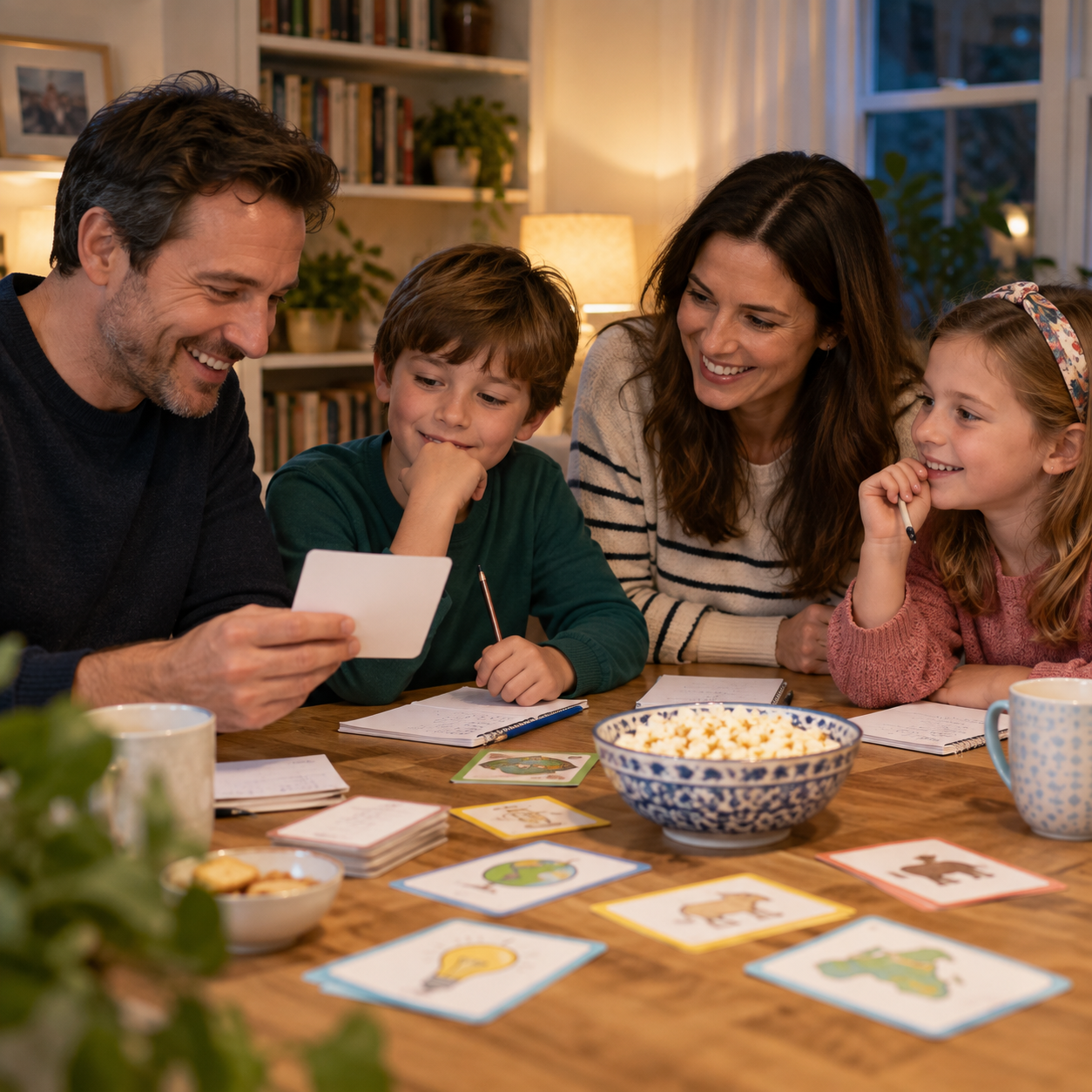
Learning does not always need to happen at a desk. Some of the most valuable opportunities for children to develop their vocabulary, knowledge and confidence can happen during ordinary family activities. A simple quiz night at home is a great example.
Family quiz nights can turn learning into something social and enjoyable. Children hear unfamiliar words, recall facts, make connections between different subjects and practise explaining what they know. They can also discover new interests without feeling as though they are completing extra schoolwork.
For parents looking for easy ways to support learning at home, a regular family quiz can be surprisingly effective. It requires very little preparation and can be adapted for different ages, abilities and interests. It can also be made accessible for children and young people with SEND.
Why Vocabulary and General Knowledge Matter
A broad vocabulary helps children in almost every area of education. The more words a child understands, the easier it can become to follow instructions, understand what they are reading and express their ideas clearly.
Vocabulary is not only important in English lessons. A maths problem might use words such as difference, estimate or approximately. Science introduces terms such as evaporation, habitat and gravity, while subjects such as History and Geography bring their own specialist language.
General knowledge is equally valuable. Knowing something about countries, historical events, nature, science, literature, art and everyday life gives children a bank of information that they can draw upon when they encounter new topics.
Knowledge also helps with reading comprehension. A child may be able to read every word in a passage but still struggle to understand it if they have little background knowledge about the subject.
Family quiz nights provide a relaxed way to keep expanding both vocabulary and general knowledge over time.
How Family Quiz Nights Build Vocabulary
During a quiz, children are naturally exposed to words that they might not encounter in everyday conversation.
Imagine a question asking, “Which planet is famous for its rings?” A younger child might learn the word planet. Another question could introduce words such as capital, continent, mammal, author or temperature.
The real learning often happens after the answer has been given.
Rather than simply moving immediately to the next question, parents can briefly discuss unfamiliar words. If the answer is “Saturn”, for example, you might talk about what a planet is and whether your child knows the names of any others.
This does not need to become a lengthy lesson. A short explanation can be enough to give a child another encounter with a useful word.
Repeated exposure matters too. Children rarely learn a new word permanently after hearing it once. Encountering vocabulary again in different contexts helps strengthen understanding. If a word from a previous quiz appears in a book, television programme or conversation later, parents can make that connection.
Over time, these small encounters can build into a much broader vocabulary.
Quizzes Encourage Children to Retrieve What They Know
Quiz nights (or afternoons, whenever suits!) are not only about learning new information. They also encourage children to retrieve information they have already encountered.
Retrieval means bringing information back to mind rather than simply looking at it again. A child might have learned the names of the continents at school, for example, but answering a question about them requires them to recall that knowledge independently.
This can help strengthen learning.
The important thing at home is to keep retrieval low pressure. A family quiz does not need to feel like a test. Children should be able to guess, ask for a clue or say that they do not know.
Getting an answer wrong can actually lead to a memorable learning moment. Children often remember surprising answers precisely because they guessed incorrectly first.
The aim is curiosity rather than a perfect score.
General Knowledge Helps Children Make Connections
One of the benefits of general knowledge is that subjects do not exist in isolation.
A question about volcanoes might connect Geography and Science. A question about the Romans could lead to a conversation about History, language or places in Britain. A question about an animal might introduce ideas about habitats, continents and adaptation.
These connections can help children understand new information more easily.
Imagine a child reading a story set in ancient Egypt. If they already know what a pharaoh was, where Egypt is and something about pyramids, they have useful background knowledge to help them understand the story.
This is why broad general knowledge can support learning well beyond a quiz itself.
Making Quiz Nights Work for Younger Children
For younger children, quizzes should be short, concrete and playful. There is little benefit in asking question after question that is far beyond their current knowledge.
Children in the Early Years or Key Stage 1 might enjoy questions about animals, colours, numbers, familiar stories, food, seasons and the world around them.
Visual questions can work particularly well. You might show a picture of an animal and ask where it lives, or point to something in the room and ask your child to describe it.
Parents can also use multiple-choice questions when recall is difficult. Instead of asking, “What is the capital of France?”, you could ask, “Is the capital of France Paris, Madrid or Rome?”
Most importantly, celebrate thinking rather than simply getting the right answer. Comments such as “That was a good guess” or “I like how you thought about that” can help keep the activity positive.
Quiz Ideas for Primary-School Children
As children move through primary school, quizzes can begin to include a wider range of topics.
Questions might relate to subjects they encounter at school alongside areas of personal interest. A football fan could answer questions about teams, countries and stadiums, while a child who loves animals might enjoy questions about habitats, food chains and unusual species.
This is also a good age to start discussing the meaning of words within questions.
If a child does not understand the word nocturnal, for example, explain it and then ask them whether they can think of an animal that is active at night. This turns one quiz question into an opportunity to develop vocabulary and reasoning.
Parents can also encourage children to create their own questions. Writing a good quiz question requires a child to know the answer, think of plausible alternatives and communicate the question clearly.
That can be a valuable learning activity in itself.
Quiz Nights for Secondary-School Students
Family quiz nights do not need to stop once children reach secondary school. The style simply needs to change.
Teenagers may be less enthusiastic about a quiz that feels deliberately educational, so it can help to include categories they genuinely enjoy. Music, films, sport, technology, food and popular culture can sit alongside Science, History, Geography and literature.
For older students, questions can also become more challenging. Rather than only asking for individual facts, parents can occasionally ask follow-up questions such as “Why do you think that?” or “What else do you know about it?”
This encourages students to explain and connect their knowledge.
Older children can also take turns as quizmaster. Giving a teenager responsibility for preparing a round means they need to research information, check whether it is accurate and decide how to phrase their questions.
Those are useful study skills without the activity necessarily feeling like revision.
Supporting SEND Learners During Family Quiz Nights
Family quizzes can work very well for children and young people with SEND, but flexibility is important. A traditional rapid-fire quiz may create unnecessary pressure for a child who needs longer processing time, finds spoken language difficult or struggles with working memory.
The activity should be adapted to the learner rather than expecting the learner to adapt to the quiz.
For example, a child with dyslexia might find reading lengthy questions difficult but be very knowledgeable when questions are read aloud. A child with ADHD may engage more successfully with several short rounds rather than one long quiz. An autistic child may have areas of particularly strong interest or knowledge that can be incorporated into the questions.
Some children may also find competitive scoring stressful. There is no rule saying that a family quiz has to have a winner.
Families could work together as one team, collect points towards a shared target or simply play without keeping score.
Useful adaptations can include:
- reading questions aloud rather than requiring the child to read them
- offering two or three possible answers
- allowing extra thinking time without rushing
- using pictures, objects or visual clues
- including topics linked to the child’s interests
- keeping rounds short and offering movement breaks
- letting children answer by pointing, writing or choosing rather than speaking
- playing collaboratively instead of competitively.
The goal is participation, enjoyment and learning. If changing the format helps a child access the activity, that is a successful adaptation rather than making the quiz “easier”.
Practical Tips for Parents
A successful family quiz night does not require hours of preparation. In fact, keeping it simple can make it more likely to become a regular activity.
Try choosing a small number of categories and allowing each family member to contribute questions. You could have rounds on animals, places, words, Science, sport or books.
It can also help to mix easier and harder questions. If every question is too difficult, children may quickly lose interest. If everything is very easy, there is little opportunity to learn anything new.
Aim for questions that give everyone a chance to contribute.
Another useful approach is to occasionally return to previous questions. If nobody knew the largest planet in the Solar System last week, include a Jupiter question in a future quiz. This gives children another opportunity to retrieve the information.
Parents should also feel free to follow interesting conversations. If a question about Antarctica suddenly leads to a ten-minute discussion about penguins, exploration or extreme weather, the quiz has not gone off track. That conversation may be where much of the learning is happening.
Encourage Children to Ask Questions Too
One of the best things about family quizzes is that they can encourage children to become curious.
If a child asks, “Why?”, resist the temptation to rush straight to the next question. Explore it together.
Parents do not need to know every answer either. Saying “I’m not sure – let’s find out” demonstrates something important: adults continue learning too.
You could look up an answer together, find the country on a map or check the meaning of an unfamiliar word in a dictionary.
This models independent learning and shows children what to do when they encounter something they do not understand.
Let Children Become the Quizmaster
Taking turns to create the quiz can make the activity even more valuable.
When children write their own questions, they have to think differently about information. They need to decide what they want to ask, check the correct answer and work out how to communicate the question clearly enough for someone else to understand.
Younger children might prepare three questions about their favourite animal or book. Older primary pupils could create an entire category, while secondary-school students could research a specialist round.
Parents might be surprised by how much children enjoy testing the adults.
It also changes the dynamic. Instead of learning being something that adults always direct, children have an opportunity to become the expert.
Avoid Turning Family Quiz Night Into Homework
There is an important balance to strike.
If every incorrect answer results in an explanation, worksheet or correction, children may quickly realise that “quiz night” is simply another name for extra homework.
Keep explanations short and natural. Follow children’s curiosity when it appears, but do not force every question to become a teaching opportunity.
Humour, silly questions and family-specific rounds can all have a place too.
You could even include a round where children are likely to know more than the adults. Questions about a favourite game, book series or current interest can give them the satisfaction of being the expert.
Learning at home is often most effective when children do not feel that every activity is being measured.
A Simple Activity With Long-Term Benefits
Family quiz nights are not a replacement for reading, schoolwork or individual academic support. However, they can be a valuable addition to the many everyday experiences that help children learn.
A few questions around the kitchen table can expose children to new vocabulary, encourage them to retrieve existing knowledge and spark conversations about subjects they may never have explored otherwise.
They can work for young children, primary pupils and teenagers, and the format can be adapted so that SEND learners can participate in ways that suit their individual needs.
Perhaps most importantly, quiz nights can show children that learning is not confined to the classroom.
Knowledge can be shared, questioned, discussed and enjoyed. When families create an environment where it is normal to wonder, guess, ask questions and discover new things together, they help children develop something even more valuable than a good quiz score: curiosity.