
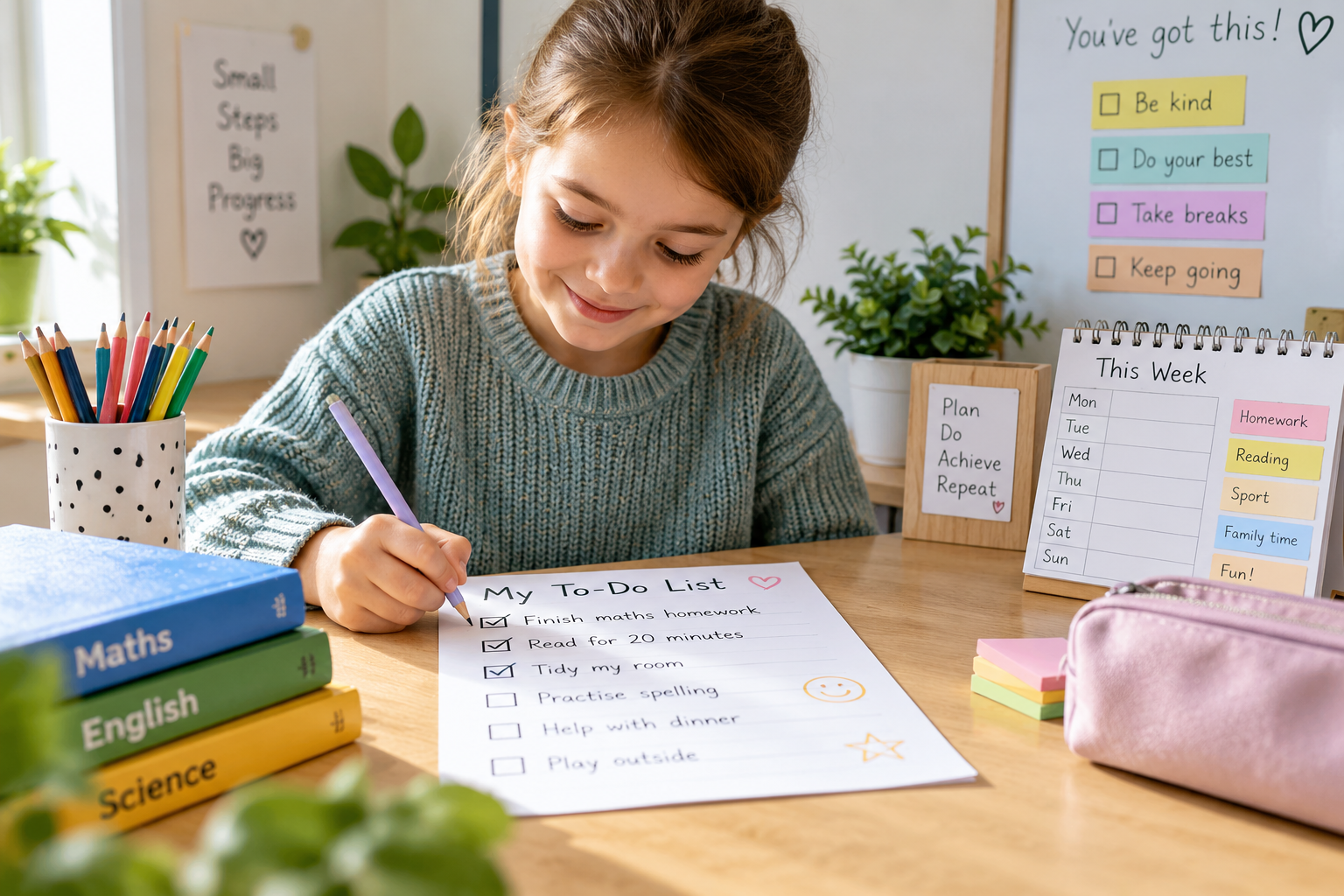
For adults, writing a to-do list can feel like a very ordinary part of everyday life. We might jot down jobs for the day, make a shopping list, plan what needs to be completed at work or write a few reminders before a busy weekend. For children, however, learning how to make and use a simple to-do list can be a surprisingly valuable educational activity. Keep reading to the end to download our free resource to help your child get started!
A to-do list does much more than help children remember what they need to do. It encourages them to think ahead, organise tasks, decide what should happen first and monitor their own progress. These are all important executive function skills that support learning both inside and outside the classroom.
Executive function skills are sometimes described as the brain’s management system. They help us plan, concentrate, remember instructions, manage our time, control impulses and move successfully from one task to another. Children are not born with fully developed executive function skills. These abilities develop gradually throughout childhood and adolescence, and everyday activities can give children valuable opportunities to practise them.
Making a to-do list is one of the simplest ways parents can encourage this development at home.
What Are Executive Function Skills?
Executive function is an umbrella term covering several mental processes that allow us to organise our thoughts and behaviour in order to achieve a goal.
Imagine a child has been asked to complete their homework, pack their PE kit and remember to take a reading book to school the following morning. Knowing that these things need to happen is only part of the challenge.
The child also needs to remember the instructions, decide when to complete each task, gather the things they need, resist distractions and recognise when each job has been finished. If something changes – perhaps they cannot find their PE shirt – they may also need to adjust their plan.
All of these processes involve executive function.
For younger children, adults naturally provide much of this structure. We remind them what comes next, help them find their belongings and break larger jobs into manageable steps. As children get older, however, they gradually need to take responsibility for more of this organisation themselves.
A simple to-do list can act as a bridge between these two stages.
Why Making a To-Do List Helps Children
One of the biggest advantages of a to-do list is that it takes information out of a child’s head and puts it somewhere they can see it.
Working memory – our ability to hold and use information temporarily – has limited capacity. If a child is trying to remember several instructions at once, some of that information can easily be forgotten.
Writing tasks down reduces this pressure.
Instead of repeatedly thinking, “I need to remember my homework, my water bottle, my reading book and my football kit”, the child has an external reminder they can refer to.
This frees up mental capacity for actually completing the tasks.
A written list can also make an overwhelming collection of responsibilities feel much more manageable. “Get ready for school tomorrow” is a broad instruction. A list containing “pack school bag”, “find PE kit”, “put reading book in bag” and “fill water bottle in the morning” gives the child a much clearer route towards the goal.
To-Do Lists Teach Children How to Break Down Tasks
One important executive function skill is being able to break a large task into smaller steps.
Adults often do this without thinking about it. If we decide to cook dinner, for example, we understand that this involves choosing what to make, checking ingredients, preparing food, cooking it and clearing up afterwards.
Children may see only the final goal.
This can be particularly noticeable with homework or revision. “Revise science” is a large and rather vague task. A child may know they need to do it but have no idea where to begin.
Helping them turn this into smaller actions makes the task more approachable. They might decide to read one section of their textbook, review their class notes, make five revision cards and answer three practice questions.
The same principle can be applied to everyday life. Tidying a bedroom can become putting clothes away, clearing the desk, putting books back on the shelf and making the bed.
Learning to identify these smaller steps is a skill children can eventually transfer to larger academic tasks.
Developing Prioritisation Skills
Not everything on a to-do list is equally important.
Children therefore need opportunities to learn how to prioritise.
Suppose a child has Maths homework due tomorrow, a History project due next week and a bedroom that needs tidying. Which should come first?
Rather than immediately giving the answer, parents can use questions to encourage the child to think about priorities. When does each task need to be completed? How long is it likely to take? Is anything dependent on another task being finished first?
This gradually introduces the idea that effective organisation is not simply about completing tasks in the order we happen to remember them.
For older pupils, prioritisation becomes increasingly important as homework demands grow and different subjects compete for their attention. By GCSE and A-level, students may be balancing homework, revision, coursework, extracurricular activities and other commitments.
Learning how to decide what requires attention first can make this workload feel considerably more manageable.
To-Do Lists Can Improve Time Management
Children can also use their lists to develop a better understanding of time.
Young people often underestimate or overestimate how long something will take. A child might expect a piece of homework to take ten minutes when it actually takes forty. Alternatively, they may avoid beginning a task because they imagine it will take the entire evening when it could realistically be finished in twenty minutes.
Parents can encourage children to estimate how long individual jobs will take and then compare those estimates with reality.
This does not need to become another test. The aim is simply to help children develop a more accurate sense of time.
Gradually, they may become better at planning their evenings and recognising how much they can realistically achieve.
The Satisfaction of Ticking Something Off
There is also something psychologically satisfying about completing a task and ticking it off a list.
For children, this provides visible evidence of progress.
A child faced with six jobs at the beginning of the afternoon might initially feel that they have a lot to do. Once four have been crossed out, however, they can clearly see how much they have already achieved.
This can help with motivation, particularly when larger jobs have been broken into smaller stages.
Parents should be careful not to turn the list into a constant source of pressure. The purpose is to provide structure and encourage independence, rather than create another way of measuring productivity.
Some days, not everything will get done. That provides another useful opportunity to practise executive function: deciding what needs to move to tomorrow’s list.
How Parents Can Introduce To-Do Lists at Home
A child’s first to-do list should be simple.
There is little benefit in giving a seven-year-old a detailed daily planner containing fifteen tasks. The organisational tool itself can quickly become overwhelming.
Instead, begin with a small number of achievable jobs. Depending on the child’s age, these might include:
- putting their reading book in their school bag;
- completing one piece of homework;
- putting dirty clothes in the laundry basket;
- practising spellings for ten minutes;
- finding their PE kit;
- reading a chapter of a book;
- packing what they need for an after-school activity.
Children can write their own lists, dictate them to an adult or use pictures and symbols if they are not yet confident readers.
The important part is gradually involving the child in deciding what needs to be done rather than simply presenting them with another set of adult instructions.
To-Do Lists for Primary-School Children
For younger primary children, to-do lists should be short, visual and focused on immediate tasks.
A list for after school might contain only three things: put lunchbox in the kitchen, read for ten minutes and put tomorrow’s school things by the door.
Pictures can work well for younger children. A drawing of a book, school bag or football kit can act as a visual reminder without requiring lots of reading.
At this age, children will usually still need adult support. Parents might sit down with them and ask, “What do we need to remember for tomorrow?”
This wording is important because it makes the planning process collaborative.
Over time, parents can provide fewer prompts and see whether the child begins remembering tasks independently.
Supporting Secondary-School Pupils
The transition to secondary school often places much greater demands on executive function skills.
Instead of having one main classroom and teacher, pupils may need to move between different rooms, remember equipment for several subjects and keep track of homework set by multiple teachers.
A simple planning system can therefore be extremely useful.
Secondary pupils might keep a daily list alongside a weekly overview. The weekly plan shows upcoming deadlines and commitments, while the daily list identifies what actually needs to happen that evening.
It can also help to distinguish between tasks that must be completed and tasks that would be useful if there is enough time.
This prevents an ambitious list from becoming discouraging.
To-Do Lists and GCSE or A-Level Revision
For students preparing for GCSEs or A-levels, effective planning becomes even more important.
A revision list that simply says “Maths, English, Biology” does not provide much direction.
More specific tasks are easier to begin and easier to measure. “Complete ten simultaneous-equation questions” or “plan an essay on Macbeth’s ambition” gives the student a clear target.
This is where earlier experience of breaking tasks into smaller steps can become particularly valuable.
Students can also learn to review their lists at the end of the day. What was completed? What took longer than expected? Is anything being repeatedly postponed?
These questions encourage students to think about how they learn rather than simply whether they have worked for a particular number of hours.
To-Do Lists for Children With SEND
To-do lists can be particularly helpful for some children and young people with special educational needs and disabilities (SEND), although they should always be adapted to the individual learner.
Children with ADHD, for example, may find it difficult to hold several instructions in mind, organise a sequence of tasks or resist distractions. A short, visible list can reduce the reliance on working memory and provide a clearer structure for what needs to happen next.
Some autistic children may also find visual schedules and predictable sequences reassuring. Knowing what is expected and what will happen next can reduce uncertainty.
However, a long list can have the opposite effect and become overwhelming. Breaking tasks into very small steps, using visual symbols, including breaks and limiting how much appears on the page at once may be more effective.
Children with dyslexia or other literacy difficulties should not have to struggle through a text-heavy organisational system. Colour coding, symbols, voice notes, photographs or digital reminders may work better.
The goal is not to teach every child to organise themselves in exactly the same way. It is to help each child discover tools that make planning and organisation easier for them.
Paper Lists or Digital Lists?
There is no single correct format.
Some children enjoy physically writing a list and crossing things out. Others prefer a whiteboard, sticky notes or a notebook.
Older children may prefer a digital task list on a phone, tablet or computer.
The format matters less than the thinking behind it.
A beautifully organised app will not improve executive function if a student simply types every task into it and never looks at it again. Equally, a scrap of paper can be highly effective if the child actively decides what needs doing, prioritises the tasks and reviews their progress.
Parents may need to experiment with different approaches before finding something that works.
Avoid Taking Over the Planning Process
There is an important difference between creating a to-do list for a child and teaching a child how to create one themselves.
If parents always decide what goes on the list, organise it and remind the child to check it, much of the executive-function work is still being done by the adult.
Initially, this support may be necessary. However, it can gradually be reduced.
Instead of saying, “Write down your Maths homework”, try asking, “What have you got due tomorrow?”
Instead of saying, “Do your English first”, ask, “Which task do you think needs doing first, and why?”
These small changes encourage children to become active participants in the planning process.
Mistakes are also part of learning. Forgetting something occasionally, underestimating how long homework will take or creating an unrealistic list can provide useful feedback. The aim is not perfect organisation from the beginning. It is gradual improvement.
Executive Function Skills Extend Beyond School
Although to-do lists can help with homework and revision, the skills children develop through planning have much wider applications.
Adults use executive function constantly. We rely on it to organise work, arrive at appointments, manage household responsibilities, plan journeys, prepare meals and meet deadlines.
Teaching children how to organise themselves is therefore about much more than improving homework habits.
A child who learns to identify a goal, break it into manageable steps, decide what to do first and adjust their plan when circumstances change is developing a set of skills that will remain useful throughout adulthood.
Building Independence One Small Task at a Time
A to-do list is an extremely simple tool, but that simplicity is part of its strength.
It makes invisible thinking visible.
Instead of relying on an adult to repeatedly remind them what needs to happen next, children can begin learning how to plan, organise and monitor their own responsibilities.
For parents, the aim should not be to create perfectly organised children who complete every task without prompting. Executive function develops gradually, and different children will require different levels of support.
The more useful goal is to give children regular opportunities to practise.
Start small. Choose a few manageable tasks. Help your child decide what needs to happen and in what order. Encourage them to tick things off as they go and, importantly, talk about what worked and what did not.
Over time, the humble to-do list can become much more than a collection of reminders. It can become a practical way for children to develop the planning, organisation, prioritisation and self-management skills they need to become increasingly confident and independent learners.
Download our free resource: Free Resource: Bristol Tutors weekly planner pdf