
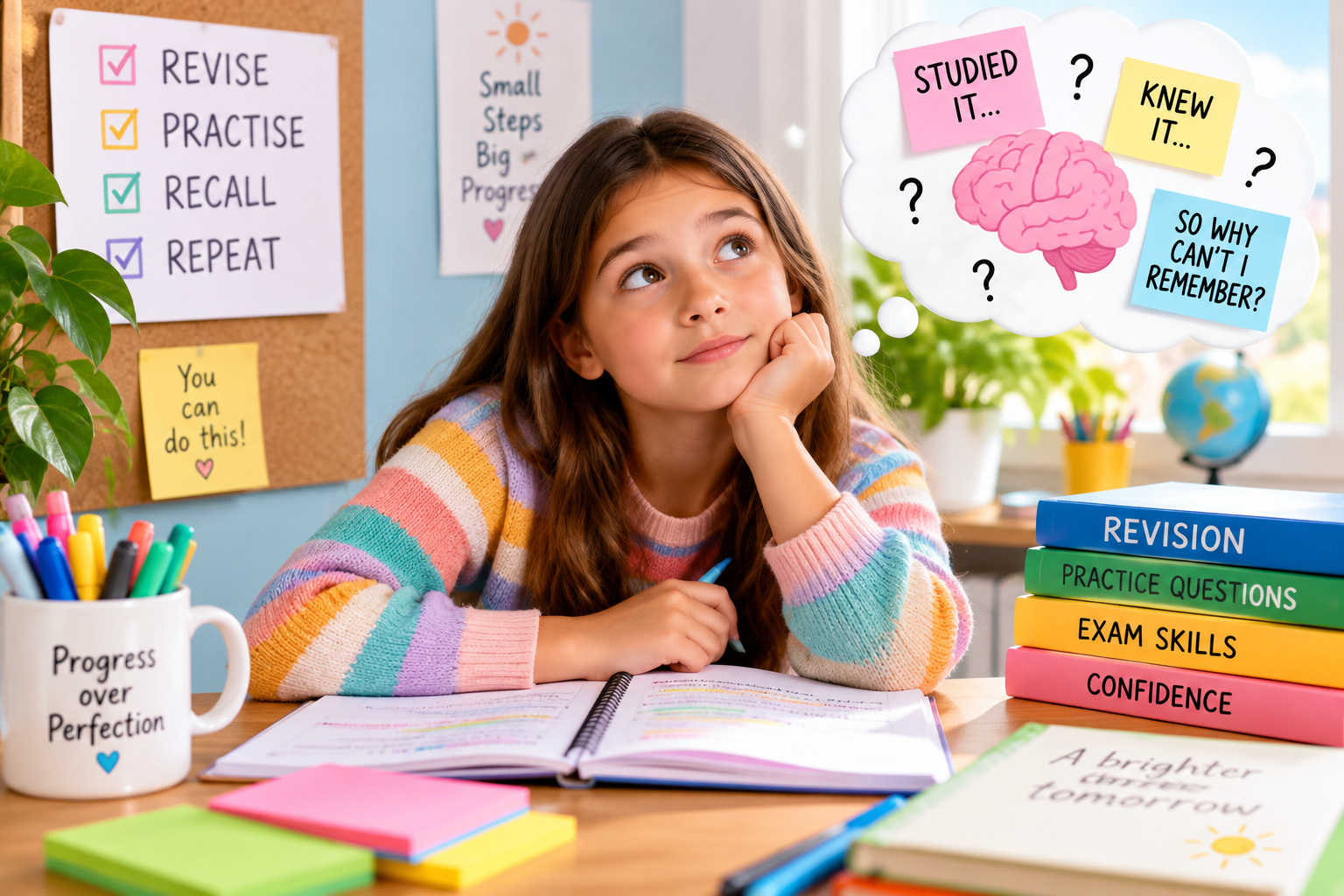
Your child has spent an hour revising. They have read through their notes, highlighted important sentences and perhaps watched a video explaining the topic. By the end of the session, everything seems familiar. They feel reasonably confident that they know it.
A few days later, you ask them a question about the same topic – and suddenly they cannot remember the answer.
For parents, this can be frustrating and confusing. Why does my child forget what they have revised? Were they not concentrating? Do they need to spend longer studying? Is there a problem with their memory?
Often, the explanation is much simpler. Your child may have experienced what is sometimes described as the illusion of learning: the feeling that we know or understand something because it looks familiar, even though we cannot yet recall or apply that knowledge independently.
Understanding this distinction can completely change the way children approach revision. Instead of simply spending more time looking at information, they can learn to use strategies that require their brains to retrieve, explain and apply it.
What is the illusion of learning?
The illusion of learning happens when familiarity is mistaken for genuine knowledge.
Imagine your child reads the same page of revision notes three times. On the third reading, the words are very familiar. They recognise the definitions and know what information is coming next. That familiarity can create a reassuring feeling: “I know this.”
But recognition and recall are not the same thing.
In an exam, pupils are rarely given their revision notes and asked whether the information looks familiar. They have to retrieve knowledge from memory, explain ideas in their own words, solve unfamiliar problems or use what they know to construct an answer.
This is why a child can genuinely feel that revision has gone well, only to struggle when completing a practice question later.
The problem is not necessarily that they have failed to work hard. Their revision method may simply be giving them an inaccurate picture of how securely they have learnt the material.
Why does my child forget what they have revised?
If you are wondering why your child forgets what they have revised, it is helpful to look at what they actually do during a typical revision session.
Reading notes, highlighting passages, copying information and watching educational videos can all have a place in learning. The difficulty comes when these activities make up almost the entire revision process.
They are often relatively passive.
Information is being presented to the learner, rather than the learner having to retrieve it independently.
For example, imagine a child is revising the causes of the First World War. They read their notes several times and recognise each cause immediately. They may feel confident.
Now close the book and ask:
“What were the main causes of the First World War?”
Suddenly, recalling them may be much harder.
That difficulty is useful information. It reveals the difference between recognising an answer and being able to produce it independently.
Why rereading notes can feel so effective
Rereading is particularly good at creating the illusion of learning because each repetition makes the material increasingly familiar.
That familiarity feels like progress.
The same can happen with highlighting. A page covered in carefully chosen colours can look as though a lot of productive work has taken place. However, unless the child later tries to recall or use the highlighted information, the activity itself does not necessarily tell them what they can remember.
This does not mean children should never reread notes or highlight information.
Reading can be an important first stage when encountering new material. Highlighting can also help a learner identify important information.
The key is what happens next.
Once a child understands the material, revision should increasingly move away from simply looking at the answer and towards trying to retrieve it.
The importance of active recall
One of the most useful ways to challenge the illusion of learning is through active recall.
Active recall simply means attempting to retrieve information from memory without looking at the answer first.
This might involve answering questions, using flashcards, completing a practice paper, writing down everything remembered about a topic or explaining an idea aloud.
The important part is the attempt to remember.
A simple revision routine might therefore be:
- Learn or review a small section of material.
- Put the notes away.
- Write down or explain everything you can remember.
- Answer a question without looking at your notes.
- Check your response against the original material.
- Identify what you missed or misunderstood.
- Return to those areas before testing yourself again later.
This process may feel harder than rereading.
That is not necessarily a bad sign.
In fact, productive revision often feels more difficult because the learner is making their brain do more of the work.
Why getting things wrong during revision can be helpful
Some children become worried when they cannot immediately remember an answer.
They may assume this means their revision is failing.
Parents can help by reframing mistakes as useful information.
If a child tests themselves at home and discovers that they cannot remember the difference between mitosis and meiosis, for example, they have discovered a gap while there is still time to address it.
That is far more useful than discovering the same gap during an exam.
Effective revision is not about proving that you already know everything. It is about finding out what you do and do not know.
This is one reason practice questions can be so valuable. They expose gaps that passive revision may hide.
Spacing revision instead of cramming
Another reason children forget what they have revised is that they may be doing too much in a single session.
A pupil might revise a topic intensively on Sunday evening and feel that they know it extremely well. However, if they never return to that material before an assessment several weeks later, much of it may become difficult to retrieve.
Spacing revision across several sessions encourages the learner to return to information after some forgetting has occurred.
For example, rather than spending three hours revising one science topic on Saturday, a learner might revisit that topic for shorter periods across several days or weeks.
Each time they return, they have to retrieve some of the information again.
This can also provide a more realistic picture of learning. If your child can answer a question immediately after reading the answer, that tells us relatively little. If they can answer it several days later without looking at their notes, their knowledge is becoming much more secure.
How younger children can avoid the illusion of learning
The illusion of learning is not only relevant to teenagers preparing for GCSEs.
Primary-aged children experience the same distinction between recognising something and being able to retrieve it independently.
A younger child might read a list of spellings repeatedly and feel that they know every word. But when the list is removed and a parent asks them to spell the words independently, some may suddenly become difficult.
The same applies to times tables, number bonds, vocabulary and factual knowledge.
For younger learners, revision does not need to look like formal exam preparation. Short games, quick quizzes, oral questions and opportunities to explain learning can all encourage retrieval.
Parents might occasionally ask, “Can you teach me how to do this?” rather than simply asking, “Do you understand?”
Explaining something to somebody else requires a child to organise and retrieve their knowledge. It can also reveal where their understanding becomes uncertain.
Revision during secondary school
As pupils move through secondary school, the amount of information they are expected to retain increases significantly.
This makes effective revision habits increasingly important.
A Year 7 pupil who learns how to self-test, revisit previous topics and identify gaps in understanding is developing skills that can become extremely valuable by Years 10 and 11.
Parents can support this without turning every evening into a test.
Instead of asking, “Have you revised?”, it can sometimes be more useful to ask:
“How did you test whether you remembered it?”
That small change focuses attention on the quality of revision rather than simply the amount of time spent revising.
GCSE and A-level revision: when familiarity becomes particularly risky
The illusion of learning can become particularly problematic during GCSE and A-level preparation because students are dealing with large specifications.
A pupil may recognise almost everything in their revision guide and therefore believe that they are well prepared.
The examination, however, requires more than recognition.
Students may need to retrieve precise terminology, connect ideas from different topics, interpret unfamiliar information, solve multi-stage problems and construct extended responses under time pressure.
This is why past papers and exam-style questions become so valuable.
They provide a much more realistic test of what a student can actually do with their knowledge.
At A-level, this becomes even more important. The volume and depth of material can make passive revision particularly deceptive. Students benefit from regularly moving between learning content, recalling it and applying it to challenging questions.
The illusion of learning and SEND learners
Children and young people with special educational needs and disabilities (SEND) may particularly benefit from revision strategies that make learning visible and manageable.
However, there is no single revision method that will suit every SEND learner.
A pupil with ADHD, for example, may find long periods of passive reading particularly difficult to sustain. Shorter retrieval activities with clear goals and regular breaks may be more manageable.
A dyslexic learner may find repeatedly reading dense pages of notes tiring and inefficient. Depending on the individual, oral recall, diagrams, flashcards, audio resources or discussing a topic with another person may provide useful alternatives.
Some autistic learners may benefit from highly predictable revision routines, clear visual organisation and knowing exactly what will be covered during each session.
Learners with working-memory difficulties may need information broken into smaller sections and revisited more frequently.
The aim should not be to make revision unnecessarily difficult. Retrieval practice needs to be appropriately scaffolded.
A child who repeatedly experiences failure when attempting to recall too much information at once may become discouraged. Instead, the task can be broken down, prompts can initially be provided, and support can gradually be reduced as knowledge becomes more secure.
For SEND learners especially, effective revision should be personalised around the learner’s strengths, needs, processing style and confidence.
How parents can tell whether revision is actually working
Parents do not need to become subject experts to help children evaluate their revision.
One of the simplest approaches is to encourage children to close the book.
After a revision session, ask them to explain what they have learnt without looking at their notes.
They might draw a diagram from memory, talk through a process, answer a few questions or write down key facts.
Another useful approach is to revisit the same material later.
If your child learnt something on Monday, ask them a couple of questions about it on Thursday. If they cannot remember much, that does not mean Monday’s session was pointless. It simply shows that the material needs another retrieval opportunity.
Over time, the goal is for information to become easier to retrieve and apply.
Confidence should come from evidence
There is an important distinction between feeling confident and having evidence that learning has taken place.
“I’ve read it five times” is evidence of effort.
“I answered eight out of ten questions correctly without looking at my notes” provides much stronger evidence of learning.
Helping children understand this distinction can make them more independent learners.
Rather than judging revision by how long they sat at a desk or how colourful their notes look, they can begin asking themselves better questions.
What can I remember without looking?
What am I still getting wrong?
Can I explain this clearly?
Could I answer an exam question about it?
What do I need to revisit tomorrow?
These are habits that can support learners far beyond one particular test.
Moving from the illusion of learning to genuine understanding
So, why does my child forget what they have revised?
Sometimes, forgetting is simply a normal part of learning. Information needs to be revisited and retrieved over time before it becomes secure.
But revision methods also matter.
Rereading, highlighting and watching videos can make information feel extremely familiar. The danger comes when familiarity is mistaken for mastery.
Effective revision gives learners opportunities to discover what they can actually remember and apply.
That might mean putting the revision guide away, attempting a question, explaining a concept aloud, completing a past-paper problem or returning to the same material several days later.
It will not always feel as comfortable as passive revision.
But that is partly the point.
When children learn to recognise the difference between “I’ve seen this before” and “I can retrieve and use this independently”, revision becomes much more purposeful.
At Bristol Tutors, one-to-one tuition can provide learners with structured opportunities to explain their thinking, practise retrieval, identify gaps and apply their knowledge with individual guidance. A tutor can also help a child discover revision strategies that suit their age, subject, confidence and individual learning needs.
Ultimately, successful revision is not about how familiar the page looks.
It is about what the learner can do when the page is no longer in front of them.