
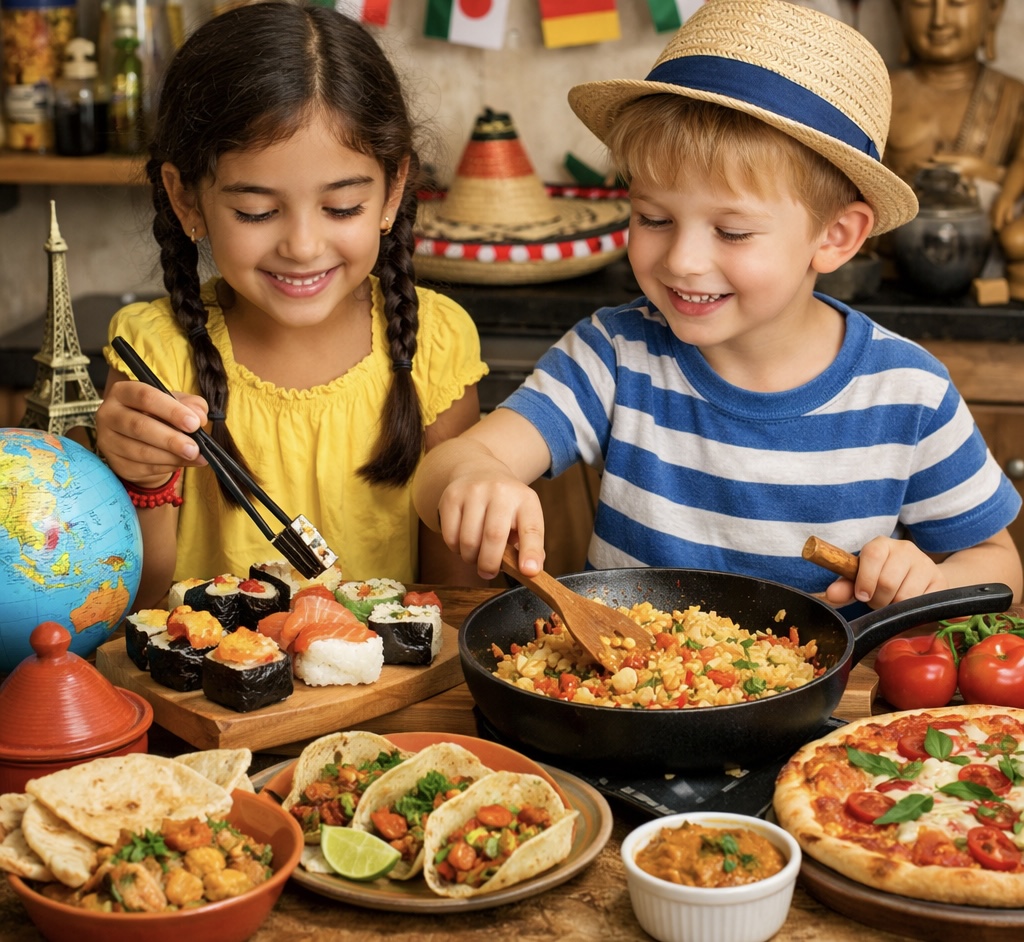
Food is a surprisingly powerful way for children to explore the world without leaving the kitchen. When families cook dishes from different countries, children gain more than just a tasty meal. They can begin to understand culture, geography, traditions and the stories behind what people eat.
Cooking world foods can transform a simple evening activity into a hands-on learning experience. Children see how ingredients travel across continents, how climate shapes diets, and how traditions influence what appears on the dinner table. This kind of learning feels natural and enjoyable, which is why it can be so powerful.
For parents and educators, cooking together offers a creative way to introduce children to the wider world.
Discovering the world through food
Children are naturally curious about what other people eat. When they try a new dish, they often ask questions about where it comes from and why it is prepared in a certain way. These questions open the door to discussions about geography and culture.
For example, cooking pasta together can lead to conversations about Italy. Children may learn that Italy is located in southern Europe and has a warm climate that supports the growth of tomatoes, olives and herbs. Making sushi at home might spark a discussion about Japan and the importance of rice and seafood in its cuisine.
Through these experiences, children begin to understand that food is closely connected to the environment where people live. Different climates, landscapes and resources influence what people grow and eat.
Understanding geography through ingredients
Cooking world foods helps children see how geography shapes diets across the globe. Ingredients that grow easily in one region may be rare or expensive in another.
For instance, tropical countries often use fruits such as mango, coconut and pineapple in everyday cooking because these grow locally. In colder climates, dishes may rely more on root vegetables, grains and preserved foods that store well through winter.
When children cook with ingredients from different parts of the world, they start to notice patterns. They see how rice is common in many Asian dishes, how maize is widely used in parts of Central and South America, and how wheat features heavily in European breads and pasta.
Looking at a world map while cooking can make these connections clearer. Children can find the country where the dish originates and begin to understand how distance, climate and geography influence food traditions.
Learning about culture and traditions
Food is closely tied to culture, history, and celebration. Cooking dishes from different countries gives children a glimpse into how people celebrate important moments and gather with family.
Many traditional recipes have been passed down through generations. Preparing these dishes allows children to explore the values and customs that shape daily life in different cultures.
For example, cooking curry might lead to discussions about festivals and family gatherings. Making dumplings could introduce children to Chinese cooking traditions and preparing tacos might open conversations about Mexican street food culture.
These experiences encourage children to see the similarities between cultures as well as the differences. Most cultures use food to bring people together, celebrate special occasions and share hospitality.
A practical example of learning through an Italian dish
A simple way to bring geography and culture into the kitchen is by preparing a basic Italian tomato pasta together. Before starting, place a world map on the table and ask children to locate Italy. You can explain that Italy is a country in southern Europe surrounded by the Mediterranean Sea and famous for foods such as pasta, pizza, olive oil, and tomatoes.
Share a few simple facts while cooking. Italy has a warm climate that is ideal for growing tomatoes and olives. Many Italian meals are based around fresh ingredients and are often enjoyed slowly with family.
Children can help measure pasta, wash basil leaves, and stir the sauce. Kids love getting involved and getting their hands dirty! As the dish cooks, ask questions that encourage curiosity. Where do tomatoes grow best? Why might people living near the sea eat a lot of seafood? How might food traditions change between northern and southern Italy?
Preparing the dish itself can be simple and practical. Cook dried pasta in a pan of boiling water while gently heating chopped tomatoes, olive oil, garlic, and herbs in another pan. Children can tear fresh basil leaves and sprinkle grated cheese over the finished dish. While eating together, you can discuss how pasta became a staple food in Italy and why wheat is widely grown across parts of Europe.
This kind of activity turns a simple dinner into a small geography lesson that children will remember.
Building curiosity about the wider world
Cooking world foods can spark a deeper curiosity about geography and global cultures. Children may want to learn more about the countries where their favourite dishes come from.
Parents can extend the learning experience by exploring maps, watching travel documentaries or reading books about different countries. Even listening to music from the same region while cooking can help children feel more connected to the culture behind the dish.
This kind of curiosity often leads to broader learning. Children might become interested in languages, tradition, and global history simply because they first discovered a new food they enjoyed.
Developing practical skills and independence
Cooking together also helps children develop important life skills. Measuring ingredients, following recipes and preparing food builds confidence and independence.
When children help cook world foods, they practise reading instructions and organising tasks in the correct order. These skills support both literacy and problem solving.
Cooking can also introduce simple mathematical concepts such as weighing ingredients, dividing portions and understanding measurements. These practical applications make learning feel meaningful and relevant.
Beyond academics, cooking encourages patience, teamwork and responsibility. Children learn that preparing food requires planning and care, and they feel proud when the finished meal is shared with the family.
Encouraging openness and respect
Trying foods from different cultures helps children develop an open minded attitude towards the world. It teaches them that people live in many different ways and that diversity should be celebrated.
Food can break down barriers. A dish that might seem unfamiliar at first often becomes a favourite after children help prepare it themselves. Through cooking, they learn that new experiences can be exciting rather than intimidating.
This openness can extend beyond food. Children who explore world cuisines may become more willing to learn about other cultures, traditions and perspectives.
Making world cooking part of family life
Introducing world foods does not need to be complicated. Many recipes are simple enough for children to help prepare with supervision.
Families might choose a different country each week and cook a dish from that region. Before cooking, children could locate the country on a map and learn a few interesting facts about its geography and culture.
Some families even turn this into a themed evening, playing music from the country or learning a few words in the local language while the meal cooks.
A few child friendly world food ideas include
- Homemade vegetable sushi from Japan
- Simple tomato pasta from Italy
- Chicken tacos from Mexico
- Mild vegetable curry inspired by Indian cuisine
- Greek flatbread with yoghurt and cucumber
Activities like these make geography feel alive and relevant. Children experience the world through flavours, ingredients and stories rather than simply reading about places in a textbook.
Creating meaningful learning moments
Cooking world foods creates natural opportunities for conversation. Parents and educators can ask questions that encourage children to think about geography and culture.
Children might consider where ingredients are grown, how food travels between countries, or why certain flavours are popular in different regions.
These discussions help children build connections between everyday life and the wider world. They begin to understand that global cultures are linked through trade, migration and shared traditions.
Most importantly, these lessons take place in a relaxed and enjoyable setting. Learning happens through curiosity and exploration rather than pressure.
A global classroom at the kitchen table
The kitchen can become a global classroom where children discover the richness of cultures and landscapes across the world. Cooking together offers a simple way to introduce geography, cultural awareness and practical skills all at once.
When children help prepare foods from different countries, they begin to see the world as an interconnected place filled with unique traditions and shared experiences.
These early lessons can shape how children view diversity and global communities throughout their lives. A simple recipe can become the starting point for a lifelong curiosity about cultures, travel and the geography of our planet.
By cooking world foods together, families do more than prepare dinner. They create meaningful learning experiences that bring the world closer to home.
External recipe inspiration
Parents looking for simple world food recipes to try with children may find inspiration from the following websites
BBC Good Food
https://www.bbcgoodfood.com/recipes/collection/kids-cooking-recipes
National Geographic Kids ideas
https://kids.nationalgeographic.com