
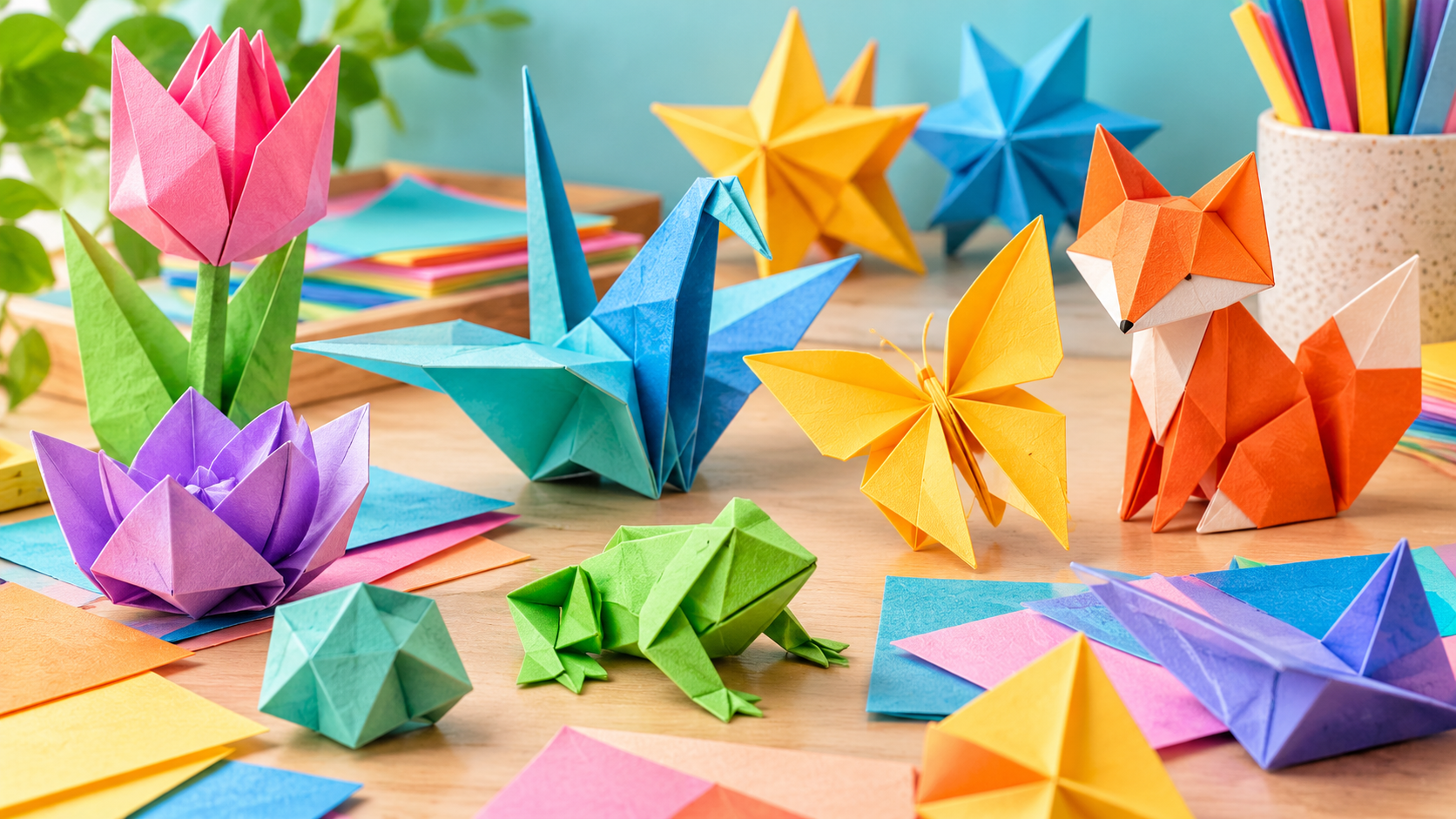
A square of paper might not look like an educational resource. However, with a few careful folds, it can become a boat, an animal, a flower or a surprisingly complicated geometric model. Origami is often thought of simply as a creative activity, but the process of folding paper can also encourage children to practise a range of important learning skills.
In particular, origami can help children develop concentration and spatial awareness. To successfully follow a sequence of folds, children need to pay attention, interpret visual information, understand how shapes relate to one another and think ahead to what their actions will produce.
These skills are useful far beyond craft activities. Spatial awareness supports learning in subjects such as maths, science, geography, design and technology, while concentration is important across almost every area of education.
Perhaps most importantly, origami provides an opportunity to practise these skills without making the activity feel like additional schoolwork.
What Is Spatial Awareness?
Spatial awareness is our understanding of where objects are positioned in relation to ourselves and to other objects. It includes concepts such as above and below, left and right, near and far, inside and outside, as well as an understanding of shape, size, direction and orientation.
Children use spatial awareness constantly. They use it when they organise objects on a desk, interpret a diagram, estimate whether something will fit into a particular space or understand the relationship between different shapes.
Spatial reasoning takes this a little further. It involves mentally manipulating objects and imagining how they might look if they were rotated, moved, folded or viewed from another direction.
Origami naturally encourages this type of thinking because the paper is constantly changing. A child may begin with a square, fold it into a triangle, open it again, rotate it and then use the creases as guides for the next stage.
They therefore have to understand not only what the paper looks like now, but what will happen to it after the next instruction.
How Origami Develops Spatial Awareness
Imagine a child is told to fold the top-right corner of a square towards the centre. Before making the fold, they have to identify the correct corner, understand where the centre is and judge how one part of the shape should move in relation to another.
More complicated models introduce additional challenges. Children may need to turn the paper over, rotate it, open a pocket, reverse an earlier fold or work out which section of a diagram corresponds to the model they are holding.
This requires them to translate two-dimensional instructions into physical movements.
Over time, activities of this kind can give children useful experience of visualising transformations. They begin to see that shapes are not necessarily fixed. A square can become two triangles, a triangle can be folded into a smaller shape, and a flat piece of paper can eventually become a three-dimensional model.
That makes origami particularly interesting from a mathematical perspective.
Origami and Maths
Origami contains a surprising amount of maths.
Children encounter symmetry when they match one side of the paper to another. They explore fractions when they fold paper into halves or quarters. They work with angles, lines, triangles, squares and other geometric forms, often without consciously thinking of the activity as a maths lesson.
A simple instruction to fold a square in half diagonally, for example, creates two triangles. Folding it horizontally instead creates rectangles. Opening the paper afterwards reveals lines of symmetry and intersections that can be discussed and explored.
Older children can investigate these ideas more explicitly. Parents or tutors might ask why a particular fold creates equal sections, how many lines of symmetry a model contains or what angles have been produced.
The aim does not need to be to turn every creative activity into a formal lesson. Simply drawing attention to the mathematical ideas occasionally can help children recognise that maths exists outside textbooks and worksheets.
This can be particularly valuable for children who are less confident with traditional maths activities. Encountering geometry through a practical task may make some concepts easier to visualise.
Why Origami Requires Concentration
Origami is also an exercise in sustained attention.
Most models involve a sequence of instructions that need to be completed in the correct order. Missing one stage or making an inaccurate fold can affect everything that follows.
Children therefore have a clear reason to pay attention.
Unlike being told simply to “concentrate”, origami gives concentration a purpose. The child wants to find out whether the paper will eventually become the object pictured in the instructions.
This can encourage them to stay with a task for longer, particularly when the model is appropriately challenging.
There is also an immediate connection between attention and outcome. A carefully aligned fold generally makes the next stage easier. If a fold is rushed, the model may become uneven. Children can see the consequences of slowing down, checking instructions and working carefully.
These are valuable learning habits that can transfer to classroom work and independent study.
Following Instructions Step by Step
Many school tasks require children to process information sequentially. They may need to follow several instructions in a maths problem, complete stages of a science experiment or plan and structure a longer piece of writing.
Origami offers another way to practise sequential thinking.
A child has to establish what they need to do first, complete that action accurately and then move on to the next stage. As the model becomes more complicated, they also need to remember what has already happened and understand how earlier folds affect later ones.
For younger children, parents can give one instruction at a time. As confidence develops, children can begin following illustrated instructions independently.
This gradual move towards independence is useful because it encourages children to rely less on an adult immediately stepping in when something becomes difficult.
Learning to Slow Down and Check
Children sometimes lose marks in school not because they do not understand a topic, but because they rush. They may misread a question, skip an instruction, overlook an important detail or fail to check their work.
Origami creates a natural reason to slow down.
If two edges are supposed to meet, children can immediately check whether they do. If the paper needs to be turned over before the next fold, they have to notice that instruction. If their model suddenly looks very different from the example, they can go back and identify where something changed.
This introduces a simple but important learning cycle: look, act, check and adjust.
That same habit can be useful in academic work. In maths, a child might check whether they have copied a number correctly. In English, they might reread a sentence. In an exam, they might return to the wording of a question before committing to an answer.
Origami will not automatically transform a child’s concentration, but it provides an enjoyable environment in which careful attention has an obvious purpose.
Developing Fine Motor Control
Paper folding also requires controlled hand movements. Children need to line up edges, hold paper steady, press folds firmly and manipulate increasingly small sections of a model.
For younger children in particular, this can provide useful practice in fine motor control and hand-eye coordination.
These physical skills contribute to many everyday classroom activities, including handwriting, drawing, using rulers and other equipment, cutting with scissors and organising materials.
The complexity of the model should always be appropriate for the child’s age and abilities. A young child does not need to produce an elaborate origami dragon to benefit from paper folding. Simple boats, hats and animals can provide plenty of practice.
Origami Encourages Problem-Solving
Eventually, almost everyone attempting origami reaches the moment when their paper does not look like the picture.
This can be one of the most educational parts of the activity.
Rather than immediately starting again, encourage children to investigate. Which fold appears to be different? Is the paper facing the correct direction? Was something folded forwards instead of backwards? Can they unfold one or two stages and try again?
This turns a mistake into a problem-solving exercise.
Children learn that getting something wrong does not necessarily mean the entire activity has failed. Sometimes the solution is to examine what has happened, identify the problem and make a small adjustment.
This mindset is valuable in academic learning, where mistakes can provide useful information about what needs to change.
Building Perseverance Through Small Successes
Some origami models can look intimidating when children see the finished version. However, the final object is usually created through a series of relatively small actions.
That makes origami a useful illustration of how complicated tasks can become manageable when they are broken into stages.
The first fold may seem insignificant. So might the second. Gradually, however, the paper begins to resemble something recognisable.
For children who become overwhelmed by larger school tasks, this can reinforce an important principle: you do not always need to understand or complete everything at once. You can focus on the next manageable step.
Completing a model also provides a tangible sense of achievement. The child can hold the finished result and see what their concentration and persistence have produced.
A Simple Origami Exercise to Try at Home
One of the easiest ways to explore origami at home is to make a simple origami dog face. It requires only a square piece of paper and a pen or pencil, and the folds are straightforward enough for a parent and child to try together.
Follow these steps:
- Place a square piece of paper in front of you like a diamond. Fold the top corner down to meet the bottom corner, creating a triangle. Turn the triangle so the long straight edge is at the top. Fold the left and right corners down at an angle to create two floppy ears. Fold the bottom point upwards slightly to make the dog’s muzzle. Finally, draw on two eyes and a nose.
While making the dog, parents can introduce some simple spatial and mathematical language. Ask your child what shape the paper becomes after the first fold. Can they make the two ears roughly symmetrical? Which direction are they folding each corner? What would happen if one ear were folded at a very different angle from the other?
You could also unfold the model afterwards and look at the crease lines. This helps children see how a series of individual folds transformed the original square.
There is no need to make the exercise feel like a formal maths lesson. A few questions and observations are enough to draw attention to the thinking involved.
Once children have mastered the dog, encourage them to make another one without looking at the instructions. Remembering the sequence adds another challenge and allows them to practise working independently.
Origami as a Screen-Free Learning Activity
Although video tutorials can be useful for learning more complicated models, origami can also be a simple screen-free activity.
Printed diagrams or an adult demonstration allow children to focus on the physical task in front of them without notifications, games or other digital distractions competing for their attention.
This makes origami useful for quiet afternoons, rainy weekends, school holidays or short periods when parents want to encourage something creative and educational.
It is inexpensive, portable and easy to repeat. Once children have memorised a favourite model, they can practise making it independently or teach somebody else.
Teaching a model introduces another valuable skill because children must remember the sequence and explain each stage clearly enough for another person to follow it.
Why Hands-On Activities Matter in the Age of Screens
At a time when children spend an increasing amount of their day using screens, hands-on activities such as origami can provide a valuable counterbalance. Frequent exposure to fast-moving digital content, notifications and constant switching between activities can make sustained attention more difficult, particularly when children become accustomed to rapid stimulation. Origami, by contrast, encourages a slower and more focused form of engagement. Children need to concentrate on one task, follow a sequence carefully and pay attention to small details for the finished model to work. Regular screen-free activities like this can therefore give children opportunities to practise sustained concentration while also developing creativity, patience and spatial awareness.
From Paper Folding to More Confident Learning
The value of origami is not that folding paper will suddenly improve a child’s academic performance. Rather, it provides a simple and enjoyable way to practise some of the underlying skills that successful learning requires.
As children fold, rotate, compare, predict and adjust, they are developing their understanding of shape and space. As they follow instructions and check their progress, they are practising concentration and sequential thinking. When something goes wrong, they have an opportunity to problem-solve and persevere.
These same learning habits can be encouraged through tuition. A child who regularly rushes through questions, struggles to interpret diagrams or becomes overwhelmed by multi-stage problems may benefit from having the time and individual attention to explore how they approach their work.
At Bristol Tutors, one-to-one tuition can be adapted to the way an individual child learns. A tutor might break a difficult maths problem into manageable stages, use diagrams and physical examples to explain spatial concepts, or encourage a pupil to pause, check and correct their work rather than simply concentrating on reaching an answer quickly.
Over time, the aim is not simply to help children understand more subject content. It is also to help them develop the strategies, confidence and independence they need to tackle unfamiliar problems for themselves.
Origami provides a small but useful example of how those skills can develop. A child starts with a blank square of paper, follows one manageable step at a time and eventually creates something that initially seemed much more complicated. Learning often works in much the same way.