
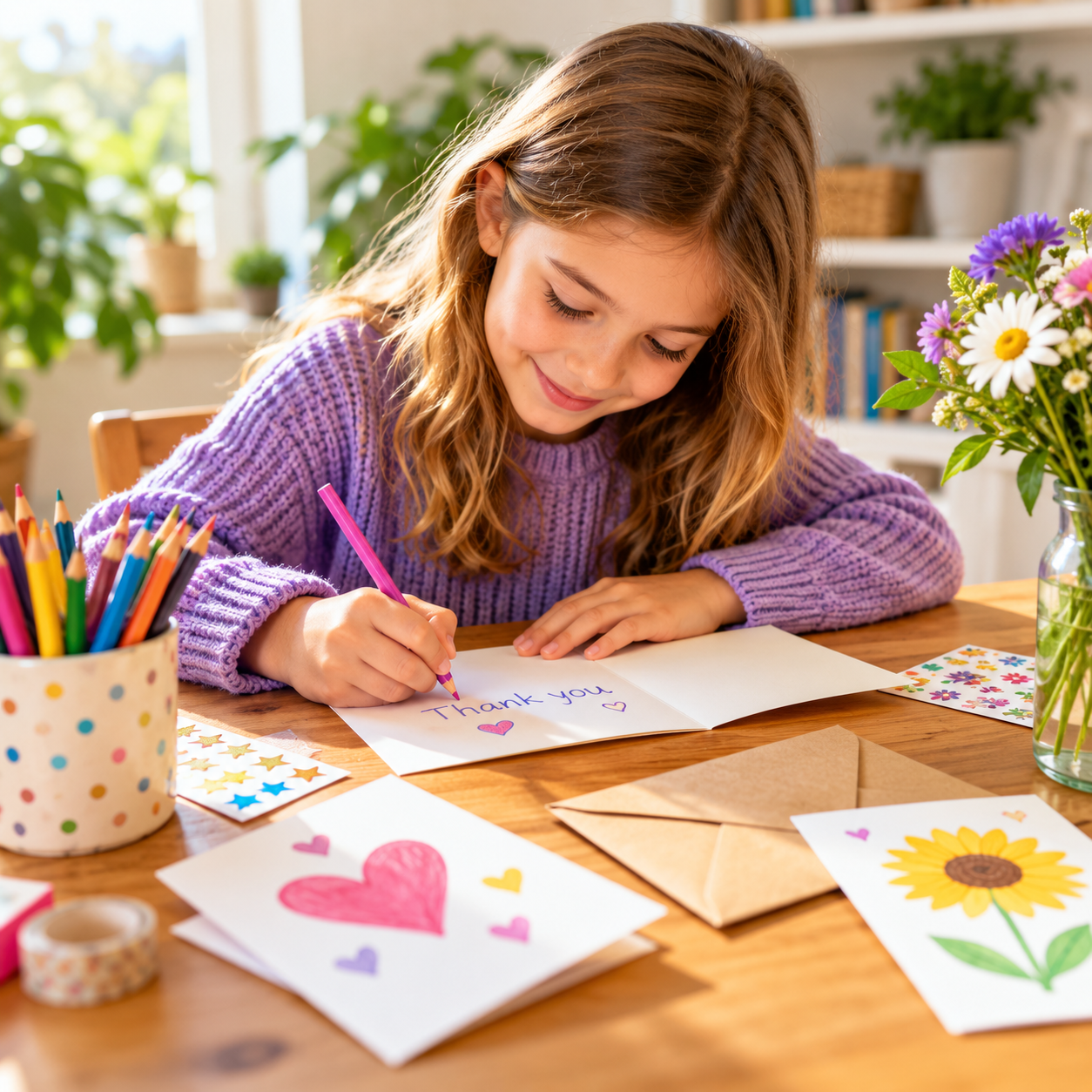
In an age of instant messaging, emails and digital greetings, the simple act of writing a handwritten thank you letter is becoming something of a lost art. What was once a familiar childhood tradition, particularly after birthdays and Christmas, is increasingly being replaced by quick text messages, emojis and online communication. While technology has made staying in touch easier than ever, there is something particularly valuable about taking the time to put pen to paper.
For children, writing thank you letters and cards offers much more than an opportunity to practise good manners. It is a meaningful learning activity that helps develop communication skills, handwriting, vocabulary, emotional awareness and the ability to express thoughts clearly. It also encourages children to consider the feelings of others and recognise the importance of showing appreciation.
Whether thanking a grandparent for a birthday present, a teacher for their support or a friend for a thoughtful gesture, handwritten letters provide an enjoyable and purposeful way to develop important literacy and social skills.
Why Is Handwritten Letter Writing Becoming a Lost Art?
Not so long ago, writing thank you letters was a regular part of childhood. After receiving birthday or Christmas presents, children would often sit down with a selection of cards, envelopes and stamps to write personal messages to relatives and friends.
Today, a quick WhatsApp message or photograph of a child enjoying their present often replaces this tradition. Although digital communication has many advantages, it rarely requires the same level of planning, reflection or written expression as a handwritten letter.
The convenience of technology also means that children have fewer everyday opportunities to practise writing for a genuine audience. Much of their written work takes place in school, where the purpose is often to demonstrate knowledge or complete an assignment.
Thank you letters are different because they have a real recipient and a meaningful purpose. Children know that someone will read their words, which can encourage them to think more carefully about what they want to say and how they communicate it.
Preserving the tradition of handwritten correspondence is therefore not simply about nostalgia. It provides children with valuable opportunities to develop skills that remain relevant in an increasingly digital world.
How Does Writing Thank You Letters Improve Communication Skills?
Effective communication involves much more than choosing the correct words. Children need to understand their audience, organise their thoughts and express ideas in ways that other people can understand.
Writing a thank you letter brings these skills together in a practical activity.
A child writing to their grandmother might use affectionate, informal language, while a letter thanking a teacher or community volunteer may require a slightly more formal tone. Learning to recognise these differences helps children understand how communication changes depending on the recipient and situation.
Children must also consider what information their reader needs. Rather than simply writing, “Thank you for my present”, they can be encouraged to explain what they particularly enjoyed and why.
For example:
“Thank you for the lovely gardening set you gave me for my birthday. I have already planted some sunflower seeds, and I am looking forward to seeing how tall they grow.”
This short message communicates appreciation while adding personal detail. It also demonstrates how writing can be used to share experiences and strengthen relationships.
Over time, practising this type of purposeful communication can help children become more confident when expressing themselves in both written and spoken language.
Developing Sentence Structure and Vocabulary Through Letter Writing
One of the greatest educational benefits of thank you letters is that they provide a natural opportunity to practise sentence construction and vocabulary.
Children often find writing easier when they have a clear purpose. Rather than being asked to produce an imaginative story about an unfamiliar subject, they can write about something they have personally experienced.
A younger child might begin with a simple sentence such as:
“Thank you for my new book. I really like the pictures.”
An older child could develop this into a more detailed response:
“Thank you for the fascinating book about space. I particularly enjoyed learning about the different planets, and it has inspired me to find out more about astronomy.”
Both examples are appropriate for different stages of development, but the second demonstrates how additional vocabulary, descriptive language and sentence variety can make communication more engaging.
Parents can encourage children to experiment with alternatives to frequently repeated words. Instead of describing every gift as “nice” or “good”, children might choose words such as thoughtful, colourful, exciting, useful or interesting.
This helps expand vocabulary while showing children how precise word choices can make their writing more meaningful.
Why Handwriting Still Matters in a Digital World
Although typing is an essential modern skill, handwriting continues to play an important role in children’s education.
Writing by hand requires children to coordinate several processes simultaneously, including letter formation, spelling, sentence construction and fine motor control.
Unlike typing, where letters appear automatically after pressing a key, handwriting involves physically forming each letter. This provides an additional opportunity to practise the movements and visual patterns associated with written language.
Thank you letters are particularly useful because they make handwriting practice feel purposeful rather than repetitive.
Children who are reluctant to complete handwriting worksheets may feel more motivated when creating a card for someone they care about. Choosing colourful paper, decorating a border or selecting a favourite pen can make the activity even more appealing.
The finished letter also provides a tangible sense of achievement. Children can hold their work, place it inside an envelope and experience the satisfaction of producing something that will be appreciated by another person.
Importantly, handwriting does not need to be perfect for a letter to be meaningful. The emphasis should be on clear communication and effort rather than flawless presentation.
How Thank You Letters Help Children Develop Emotional Awareness
Writing a thank you letter also encourages children to consider emotions, relationships and the impact of their words.
Before writing, children can be asked to think about why someone gave them a present or offered their help. Was it to celebrate an achievement, show kindness or make them feel special?
This encourages children to look beyond the gift itself and recognise the thoughtfulness behind the gesture.
For example, a child thanking a friend for helping them settle into a new school might write:
“Thank you for sitting with me at lunchtime when I was new. It made me feel much happier because I didn’t know anyone.”
This type of writing requires children to identify their feelings and explain how another person’s actions affected them.
It also introduces the idea that words can have a positive emotional impact. Receiving a thoughtful handwritten message can make someone feel valued, remembered and appreciated.
By encouraging children to express gratitude in their own words, parents can help them practise empathy and develop greater awareness of other people’s feelings.
Teaching Children How to Structure a Letter
Letter writing introduces children to an important form of non-fiction writing that differs from stories, reports and everyday messages.
Understanding how to organise a letter helps children develop their awareness of writing conventions, including greetings, paragraphs, punctuation and appropriate endings.
A thank you letter provides an accessible introduction because its structure is relatively straightforward.
Children can follow these five steps:
- Begin with a greeting: Write “Dear Grandma” or another suitable opening.
- Express appreciation: Thank the recipient for their gift, kindness or support.
- Add personal detail: Explain what they enjoyed, how they used the gift or why the gesture mattered.
- Include a friendly closing sentence: Mention something they are looking forward to or offer another thoughtful comment.
- Finish appropriately: Use an ending such as “Love from”, “Best wishes” or “From”, followed by their name.
Once children understand this structure, they can begin writing with greater independence.
Older children can also be introduced to the differences between formal and informal letters, helping them recognise how language and presentation change depending on the purpose.
These skills are useful beyond childhood thank you cards, supporting future tasks such as writing emails, applications and professional correspondence.
A Simple Thank You Letter Activity for Children to Try at Home
Parents do not need expensive resources or elaborate activities to introduce letter writing. A sheet of paper, a pencil and a genuine reason to say thank you are enough.
Start by helping your child choose someone they would like to thank. This could be a relative who recently gave them a present, a neighbour who helped the family or a teacher who encouraged them with a difficult subject.
Before writing, spend a few minutes discussing what they would like to say. Ask questions such as, “What did you appreciate most?” or “How did their kindness make you feel?”
For younger children, a simple template can make the activity more manageable.
My Thank You Letter
Dear __________,
Thank you for __________.
My favourite thing about it was __________.
It made me feel __________.
From __________
Older children can be encouraged to write independently, adding more descriptive detail or explaining how they plan to use a gift.
Once the letter is complete, allow your child to decorate it if they wish. Drawing a picture, adding a colourful border or designing a personalised card can make the experience more creative.
Finally, involve them in addressing the envelope and posting the letter. This introduces another practical life skill and helps children understand how traditional postal communication works.
Receiving a reply can be particularly exciting, reinforcing the idea that writing creates connections between people.
Supporting Children With Dyslexia, Dysgraphia or Other SEND Needs
For some children, particularly those with dyslexia, dysgraphia or other special educational needs and disabilities (SEND), handwriting and written expression can feel challenging.
A child may have wonderful ideas but struggle to organise them into sentences, spell unfamiliar words or physically write for extended periods.
Thank you letters can still be a rewarding activity when the task is adapted to individual needs.
Parents might encourage children to explain their message aloud before writing, helping them organise their thoughts without the immediate pressure of spelling or handwriting.
Sentence starters, visual prompts and word banks can also provide useful support. For children who find handwriting physically tiring, a shorter message or a combination of writing and drawing may be more appropriate.
Some children may benefit from dictating their ideas to an adult before copying a manageable section themselves. Others may prefer typing an initial draft before producing a short handwritten card.
The most important consideration is that the activity remains positive and achievable. A thoughtful two-sentence message can be just as meaningful as a full-page letter.
By celebrating effort, creativity and personal expression, parents can help children experience writing as something enjoyable rather than intimidating.
Why Writing for a Real Audience Can Increase Motivation
One challenge parents and teachers often encounter is helping children understand why writing matters outside the classroom.
Children may see writing as something they do to complete homework, practise spelling or prepare for assessments.
Thank you letters offer a different perspective because the finished work has an immediate purpose.
The child is not writing simply because an adult has asked them to complete an exercise. They are communicating with another person and sharing something meaningful.
This can be especially valuable for reluctant writers, who may respond more positively to activities connected to their own experiences.
A handwritten birthday card, a letter to a grandparent or a note thanking a sports coach can provide a sense of ownership that traditional writing exercises sometimes lack.
It also creates opportunities for children to experience positive feedback. When a relative mentions how much they enjoyed receiving a card, the child can see that their writing has made a genuine difference.
These small successes can gradually strengthen confidence and encourage children to approach future writing tasks more positively.
Bringing Back the Tradition of Handwritten Cards and Letters
Reintroducing handwritten correspondence does not mean abandoning digital communication. Both have a place in modern life, and children benefit from learning how to use different methods appropriately.
However, making time for occasional handwritten messages can help preserve a valuable tradition while supporting children’s development.
Birthdays and Christmas are obvious opportunities, but children can also write cards to thank teachers at the end of term, congratulate friends on achievements or express appreciation to family members.
Parents can make the tradition more appealing by allowing children to choose stationery, create their own cards or keep a small collection of writing materials ready for special occasions.
Writing alongside children can also be effective. When they see adults sending handwritten cards and letters, they are more likely to recognise the activity as a meaningful part of everyday life.
There is something particularly special about receiving an envelope through the letterbox containing a message that someone has taken the time to write personally.
In a world where digital messages can be sent and forgotten within seconds, handwritten correspondence offers a slower, more thoughtful form of connection.
How Tuition Can Help Children Become Confident Writers
Developing strong writing skills involves more than learning spelling rules and punctuation. Children also need opportunities to organise ideas, experiment with vocabulary, adapt their language and communicate confidently for different purposes.
Individual tuition can help children strengthen these skills through personalised activities suited to their age, abilities and interests.
For younger learners, this might involve sentence-building exercises, handwriting practice and short pieces of purposeful writing. Older children may benefit from developing paragraph structure, improving vocabulary and learning how to adjust their writing for different audiences.
A tutor can also identify specific barriers affecting a child’s confidence, whether these relate to spelling, written expression, planning or the physical demands of handwriting.
At Bristol Tutors, personalised tuition can support children in developing the literacy skills they need both inside and outside the classroom, helping them become more independent and confident communicators.
A Small Gesture With Lasting Benefits
Writing thank you letters may seem like a small, old-fashioned activity, but its educational value remains highly relevant.
It encourages children to slow down, consider their audience, organise their thoughts and communicate with care. Along the way, they can practise handwriting, spelling, vocabulary, sentence structure and emotional expression.
Perhaps most importantly, handwritten letters remind children that communication is not simply about exchanging information. It is also about building relationships, recognising kindness and making other people feel appreciated.
As handwritten correspondence becomes less common, encouraging children to write the occasional thank you card is a simple way to preserve a meaningful tradition while developing skills that will benefit them throughout their lives.
Sometimes, the most valuable learning opportunities begin with just a pen, a piece of paper and two thoughtful words: thank you.