
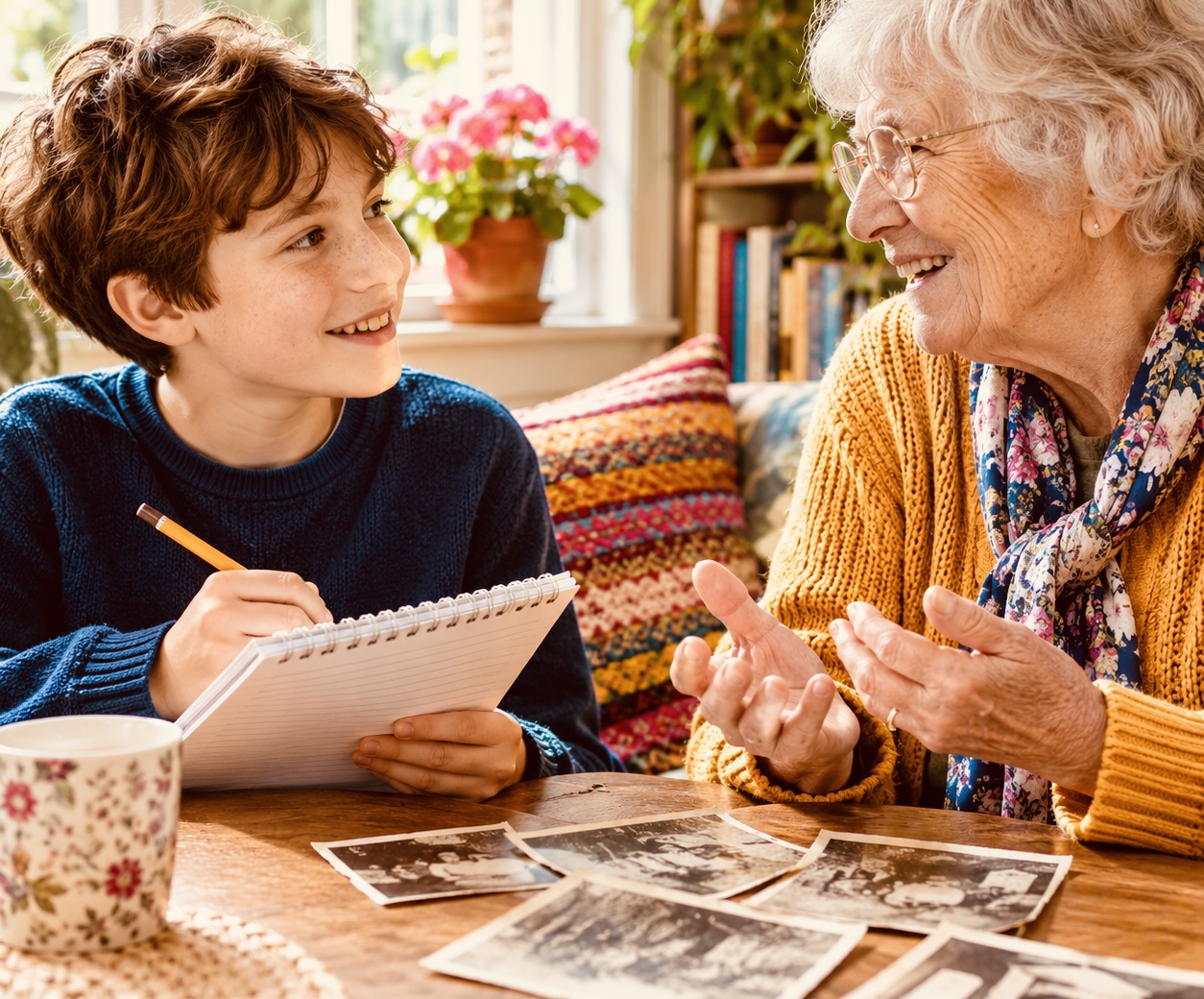
Interviewing a grandparent can be a wonderful way for children to discover family stories, practise communication skills and learn about life in the past. What might begin as a simple conversation about childhood games, school dinners or favourite memories can become a valuable educational experience that supports literacy, history, listening skills and emotional development.
For children, hearing about a world before smartphones, streaming services and modern technology can be fascinating. They might discover that their grandparents walked miles to school, played outdoors until sunset or grew up without many of the conveniences we take for granted today. These personal stories can bring history to life in ways that textbooks sometimes struggle to achieve.
However, not every child has grandparents they can speak to. Some children may have experienced bereavement, family separation or difficult relationships. Others may live with foster carers, in residential children’s homes or in other care arrangements. The educational benefits of interviewing an older person should be accessible to every child, regardless of their family circumstances.
This activity can work equally well with a trusted older neighbour, family friend, foster carer, community volunteer or another adult who has interesting experiences to share. The important element is not the family relationship but the opportunity to listen, ask questions and learn from another person’s perspective.
Why Interviewing Grandparents Is a Valuable Learning Activity
Children learn a great deal through conversations with people who have different experiences from their own. Interviewing an older person encourages them to move beyond everyday questions and develop a deeper understanding of how people live, think and remember. Unlike reading a history textbook, interviewing someone provides a personal perspective on the past, allowing children to ask follow-up questions and discover how society has changed within a relatively short period.
The activity also offers opportunities to practise several important academic skills simultaneously. Children must think about what they want to know, organise their questions, listen carefully and decide how to record the information. These are transferable skills that support classroom learning, homework, creative writing and future educational development.
How Interviewing Grandparents Develops Speaking and Listening Skills
One of the most immediate benefits of interviewing grandparents is the opportunity to practise purposeful conversation. Children often ask spontaneous questions, but an interview requires a more structured approach. They need to consider what they want to discover and how to phrase their questions clearly, which encourages them to think carefully about the language they use.
For example, asking ‘What was school like?’ might lead to a general answer. A more specific question, such as ‘What happened if you forgot your homework when you were at school?’ could encourage a more detailed and entertaining response. Children also learn that good communication involves more than speaking. They must give the other person time to answer, avoid interrupting and listen for information that might lead to another question.
These skills are particularly valuable for younger children who are still developing conversational confidence. For older pupils, the activity can introduce more sophisticated communication techniques, including open-ended questioning, clarification and summarising. A child might initially ask about favourite childhood games before following up with questions about where those games were played, who participated and why they were enjoyable.
Learning About History Through Personal Stories
History becomes more meaningful when children can connect historical events with individual experiences. A grandparent might remember life before the internet, the introduction of colour television or changes in transport, shopping and education. Some older people may also have memories of significant historical events that children have encountered in school, providing an opportunity to explore how those events affected everyday life.
For example, a child studying the development of technology might ask an older person how they communicated with friends before mobile phones existed. They could discover that people arranged meetings in advance, used public telephone boxes or wrote letters to keep in touch. These comparisons encourage children to consider how technological developments influence everyday life and whether every change has necessarily been an improvement.
This activity also introduces children to the concept of oral history, which involves collecting and preserving people’s memories and experiences. Older pupils can explore the difference between personal recollections and historical evidence, perhaps comparing an interviewee’s memories with photographs, newspaper archives or other sources. Importantly, children should understand that memories are personal perspectives and that two people may remember the same event differently.
How Interviewing Older People Improves Literacy Skills
Interviewing grandparents can support several aspects of literacy, including reading, writing, vocabulary and comprehension. Before the interview, children can prepare questions using appropriate punctuation and sentence structures. During the conversation, they may encounter unfamiliar words or expressions that encourage them to ask for explanations, helping to expand their vocabulary in a natural and meaningful context.
Afterwards, children can transform the information they have collected into a piece of writing. Younger children might create a short paragraph beginning with ‘When my interviewee was little…’ while older pupils could produce a newspaper-style feature, biography or historical report. This gives children a genuine purpose for writing and helps them understand that written communication can be used to share real experiences.
The activity also introduces children to the difference between spoken and written language. A conversation may include repetitions, pauses and unfinished sentences, whereas a written account usually requires clearer organisation. Children must decide which details are most important and how to present them logically, developing their editing, sequencing and summarising skills. For reluctant writers, having a real person’s story to work with can make the task feel more purposeful than an imaginary writing exercise.
Questions Children Can Ask Their Grandparents or Another Trusted Adult
Preparing questions beforehand can help children feel more confident and ensure that the conversation remains focused. The following suggestions can be adapted for grandparents, older relatives, foster carers, family friends or other trusted adults.
- What was your favourite game when you were younger?
- What was your school like, and which subjects did you enjoy?
- What did you usually do at weekends?
- What toys or possessions were particularly special to you?
- How did you keep in touch with your friends?
- What was your favourite meal when you were a child?
- What is the biggest change you have noticed in your lifetime?
- What did you want to be when you grew up?
- What advice would you give someone who is growing up today?
- What is a happy memory you would like to share?
Children should be encouraged to choose questions that feel appropriate for the person they are interviewing. Not everyone will want to discuss every aspect of their childhood, and some memories may be private, difficult or emotional. It is therefore important to respect personal boundaries and explain that the interviewee can decline any question. The experience should feel like an enjoyable conversation rather than an interrogation.
Inclusive Alternatives for Children Who Cannot Interview Their Grandparents
Although interviewing grandparents can be rewarding, schools and families should avoid presenting it as an activity that assumes every child has access to grandparents or a conventional family structure. Children may have lost their grandparents, have little contact with extended family or live in circumstances where discussing family relationships is difficult. An activity intended to encourage connection should never leave a child feeling excluded.
For children in foster care or residential children’s homes, an assignment focused exclusively on biological relatives may create unnecessary distress or discomfort. A more inclusive approach is to invite every child to interview an older person or trusted adult whose experiences they would like to learn about. This gives children greater choice and allows them to participate without having to explain their personal circumstances.
Suitable alternatives might include a foster carer, an older family friend, a neighbour known to the family, a teacher, a community volunteer or another appropriate adult. Children living in residential care might interview a familiar member of staff, where this is suitable and supported by their care team. However, adults should never assume that a child will feel comfortable interviewing a particular person, and participation should always respect the child’s preferences.
Using Community Connections to Explore the Past
Community organisations can offer valuable alternatives when interviewing a family member is not possible. Schools might arrange a supervised conversation with an older volunteer from a local community group, library or intergenerational project. These opportunities allow children to learn about experiences beyond their immediate family while developing confidence communicating with people from different generations.
For safeguarding reasons, schools and carers should arrange and supervise contact appropriately. Children should not be encouraged to approach unfamiliar adults independently, and any activity involving community volunteers should follow the school’s or organisation’s safeguarding procedures.
Exploring Recorded Interviews and Oral History Archives
Another accessible option is to use an existing oral history recording. Museums, libraries and heritage organisations often preserve interviews with people discussing their childhoods, work and communities. Children can listen to a recording, identify interesting details and write the questions they would have liked to ask, developing many of the same listening and comprehension skills as a live interview.
The British Library and local heritage organisations can be useful starting points for exploring historical collections and recorded memories. This approach is particularly helpful when arranging a live interview would be difficult, when a child prefers to complete the activity independently or when the subject matter requires a more carefully structured learning experience.
Interviewing Someone About Their Experiences Today
Not every interview needs to focus on distant history. A child could interview a trusted adult about their occupation, hobbies, education or experiences of learning a new skill. They might ask a teaching assistant how they became interested in education or speak to a family friend about a hobby they have enjoyed for many years.
The same communication, listening and writing skills can be developed without requiring children to explore family history. This flexibility makes the activity suitable for a much wider range of circumstances and ensures that children can concentrate on learning rather than feeling uncomfortable about their personal situation.
Making Interview Activities Accessible for Children With SEND
Children with special educational needs and disabilities (SEND) may benefit from adaptations that make interviewing more manageable and enjoyable. Some children may find spontaneous conversations challenging, particularly if they experience communication difficulties, anxiety or differences in social interaction. Others may struggle to remember questions, process lengthy answers or record information while listening.
The activity can be adjusted to reflect each child’s strengths and support needs. Rather than expecting every child to complete the same interview in the same way, parents, carers and tutors can offer different methods of communication, recording and presenting information.
Supporting Autistic Children
Some autistic children may prefer predictable conversations with a clear beginning, middle and end. Providing questions in advance can reduce uncertainty and help the child understand what will happen. A visual checklist or simple interview schedule may be useful, particularly if the child is unfamiliar with the person they will be interviewing.
It may also help to explain that the interviewee might give an unexpected answer or introduce a new topic. Children should not be pressured to maintain eye contact or use a particular conversational style, as the aim is meaningful communication rather than conformity to narrow social expectations.
Supporting Children With ADHD
Children with ADHD may benefit from shorter interviews that allow movement and changes of activity. Instead of completing ten questions in one sitting, they might ask three questions, take a break and return later. Breaking the task into manageable stages can help children remain engaged without becoming overwhelmed by the demands of a lengthy conversation.
A voice recording, with the interviewee’s permission, can reduce the pressure of taking notes while listening. Children could also draw pictures representing the answers or use simple prompts to help them stay focused. These approaches allow them to demonstrate their understanding without relying entirely on sustained attention or handwriting.
Supporting Children With Dyslexia
For children with dyslexia, writing questions and recording answers may present additional challenges. Allowing children to dictate questions, use speech-to-text software or record audio can make the activity more accessible. A parent, carer or tutor could also act as a scribe while the child takes responsibility for asking questions and deciding what information to include.
When producing a written account, children might use a template with sentence starters and clearly separated sections. The emphasis should remain on the child’s understanding and communication rather than spelling accuracy alone, particularly when the main objective is to develop listening, questioning and comprehension skills.
Supporting Children With Speech, Language or Communication Needs
Some children may communicate more effectively through pictures, symbols, signing or assistive communication technology. They could select questions from illustrated cards or use their preferred communication method to participate. Adults should allow sufficient processing time and avoid rushing to complete the child’s sentences or interpreting responses without checking their meaning.
An interview does not have to follow a traditional spoken format to be educationally valuable. The opportunity to make choices, exchange information and demonstrate curiosity is just as important as the method used to communicate.
Interviewing Grandparents at Different Ages and Educational Stages
The activity can be adapted for children throughout primary and secondary education. While younger children may concentrate on simple questions and listening skills, older pupils can use interviews to investigate historical change, develop research techniques and practise more advanced writing.
Early Years and Key Stage 1: Asking Simple Questions
For younger children, the focus should be on curiosity, listening and enjoying a shared conversation. An adult could help the child choose two or three questions, such as ‘What was your favourite toy?’ or ‘Did you have a pet when you were little?’ Children might then draw pictures of the answers or compare an older person’s favourite childhood game with one they enjoy today.
At this stage, the activity does not need to involve independent writing. The most important outcome is helping children recognise that other people have experiences and memories worth listening to, while gradually developing the confidence to ask questions.
Key Stage 2: Developing Research and Writing Skills
Children in Years 3 to 6 can begin preparing more detailed questions and recording information independently. They might investigate differences between school life today and school life several decades ago, comparing classroom technology, school uniforms, playground games and methods of travelling to school.
Afterwards, they could produce a short report explaining what has changed and what has remained similar. This creates opportunities to practise paragraph structure, chronological order and comparative language while developing a stronger understanding of how personal experiences can contribute to historical research.
Key Stage 3 and GCSE: Exploring Evidence and Perspectives
Older pupils can use interviews to explore historical reliability, social change and different perspectives. A secondary school pupil might investigate how employment opportunities, communication methods or attitudes towards education have changed over time. They could then compare an interviewee’s experiences with information from other sources and consider why memories may differ.
For GCSE English, interviewing can also provide useful practice in preparing questions, selecting quotations and presenting information for a particular audience. Students might transform their interview into a magazine article, speech or piece of descriptive writing, creating a practical connection between everyday communication and more advanced academic skills.
Building Empathy and Understanding Between Generations
Interviewing older people can encourage children to recognise that experiences differ across generations. A child might be surprised to discover that an older person once struggled with a school subject, felt nervous about making friends or worried about their future. These conversations can help children understand that adults have experienced many of the same emotions and challenges that young people encounter today.
Children may also discover different attitudes, traditions and cultural experiences. Rather than assuming that one generation’s way of living was better or worse, they can be encouraged to consider why circumstances and opportunities have changed. This supports empathy, perspective-taking and respectful discussion, while helping children appreciate the diversity of experiences within their communities.
For children who have experienced disrupted relationships or significant changes in their home lives, a carefully chosen conversation with a trusted adult may also provide a positive opportunity for connection. However, the activity should never be used to pressure a child into discussing sensitive personal experiences or family relationships.
Turning an Interview Into a Creative Learning Project
Once the interview is complete, children can use the information in several creative ways. One option is to produce a small illustrated booklet featuring questions, answers and drawings. Another is to create a timeline showing important events or changes mentioned during the conversation, helping children organise information chronologically.
Children interested in technology could produce a short audio programme or digital presentation, provided everyone involved has agreed to how the material will be used. These activities offer opportunities to develop digital literacy alongside traditional reading and writing skills.
A particularly enjoyable approach is to recreate something described by the interviewee. For example, if an older person remembers playing a particular playground game, the child could learn the rules and try it themselves. If the conversation includes memories of cooking, the child might prepare a traditional recipe with appropriate adult supervision.
These activities extend learning beyond the original conversation and help children connect information with practical experiences. They also demonstrate that research can lead to creative, meaningful outcomes rather than simply producing a completed worksheet.
Tips for Parents, Carers and Tutors Supporting the Activity
Adults can make the interview more successful by helping children prepare without taking control of the conversation. Start by discussing what the child would like to discover. Some children may be fascinated by historical events, while others may prefer learning about childhood games, food or school experiences. Allowing children to choose the topic increases their sense of ownership and makes the activity more engaging.
It is also helpful to explain that interviews do not always follow a fixed plan. An unexpected answer may lead to an interesting new question, and children should feel comfortable exploring these opportunities. For those who feel nervous, practising with a familiar adult beforehand can build confidence and reduce anxiety.
The interview should take place in a comfortable environment, with breaks available if needed. If recording the conversation, always ask permission first. Adults should also agree how recordings, photographs or written accounts will be stored and whether they may be shared. Any use of personal information, photographs or recordings should follow the relevant safeguarding and privacy arrangements.
Afterwards, encourage the child to reflect on what they discovered. Rather than focusing only on whether they asked every question, discuss what surprised them, what they enjoyed and what they might investigate further. This helps children recognise the value of their learning and encourages them to approach future conversations with greater curiosity.
Why Real-Life Learning Experiences Matter
Activities such as interviewing grandparents or other trusted adults demonstrate that valuable learning does not always require worksheets, textbooks or formal lessons. Children develop important skills through meaningful experiences that connect education with the world around them. A conversation can become a history investigation, a literacy exercise, a creative writing project or an opportunity to develop confidence.
It can also remind children that knowledge exists beyond the classroom and that people from different backgrounds have valuable experiences to share. For some learners, traditional academic activities may feel intimidating or disconnected from everyday life, whereas familiar, real-world experiences can make learning more approachable.
At Bristol Tutors, we recognise the importance of making learning engaging, practical and responsive to individual needs. With appropriate support, children can develop communication, literacy and research skills through activities that feel purposeful rather than purely academic.
Every Child Has a Story Worth Exploring
Interviewing grandparents can open the door to fascinating discoveries about history, family traditions and everyday life in previous generations. It can strengthen speaking and listening skills, encourage curiosity and provide meaningful opportunities for reading, writing and creative expression. However, the activity’s greatest value lies in the exchange of experiences, rather than the specific relationship between the child and the person being interviewed.
Children who cannot interview grandparents should have equally meaningful alternatives, whether that involves speaking to a trusted adult, participating in a supervised community project or exploring recorded oral histories. By offering flexibility, respecting personal circumstances and adapting activities for different learning needs, parents, carers and educators can ensure that every child has an opportunity to participate.
Sometimes, the most memorable learning begins with a simple question and someone willing to share their story.
If your child would benefit from additional support with English, communication, writing or confidence, Bristol Tutors offers personalised tuition designed to help learners develop their skills at a pace that suits them.