
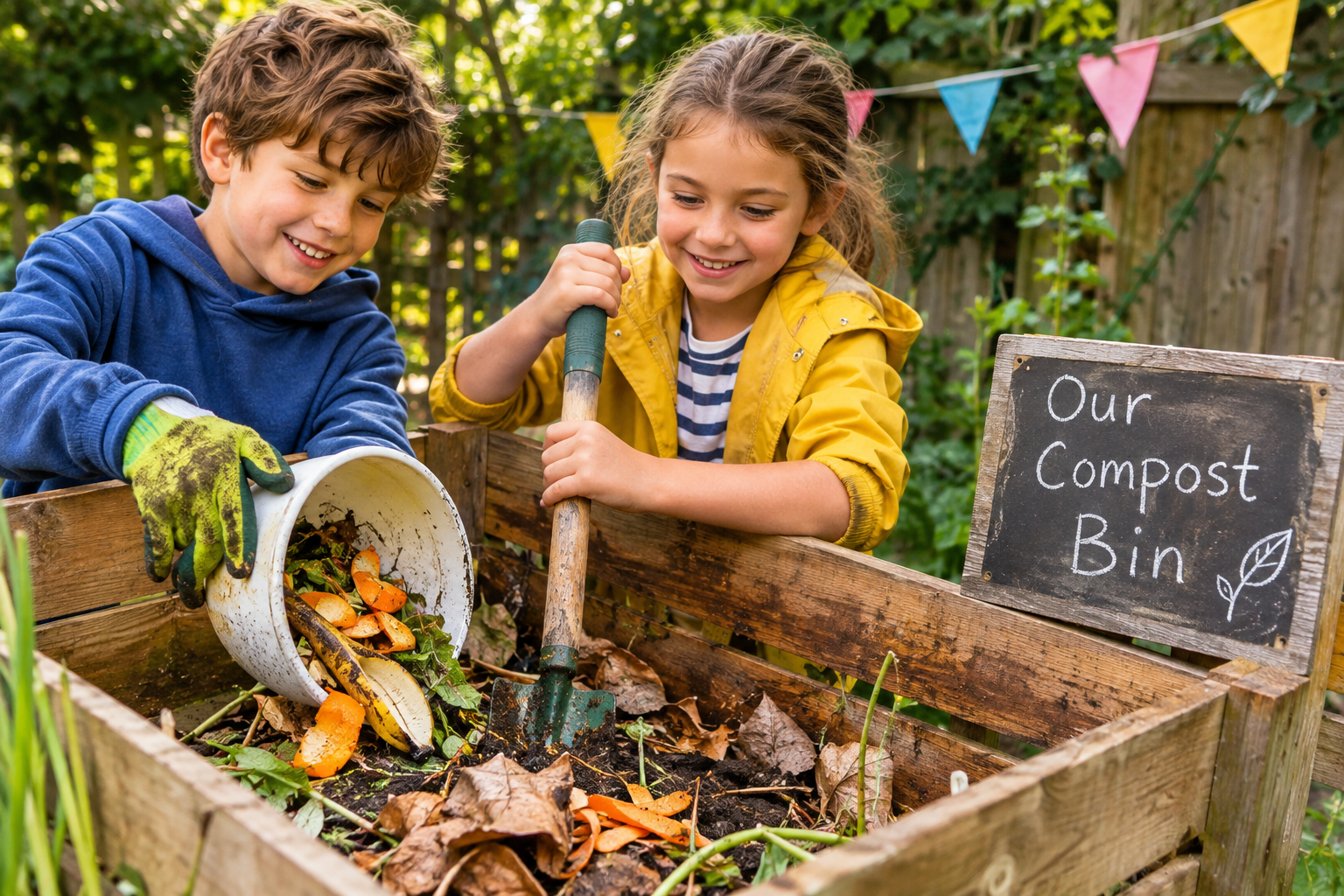
Children are naturally curious about the world around them. From watching plants grow to discovering insects beneath fallen leaves, everyday experiences provide wonderful opportunities for learning. One particularly rewarding activity involves making a compost bin at home. This simple project can introduce children to decomposition while developing scientific thinking, environmental awareness and a sense of responsibility.
Making a compost bin helps children understand decomposition by allowing them to observe how natural materials gradually break down. Rather than simply reading about the process in a textbook, children can investigate it themselves. They can make predictions, record changes and discover how microorganisms help recycle nutrients in nature.
Composting also provides an opportunity to introduce environmental conservation. Children can learn why reducing waste matters, how natural resources can be reused and why healthy soil is important for plants and wildlife. The activity brings together science, maths, literacy and practical problem-solving in a way that feels relevant to everyday life.
What Is Decomposition and Why Should Children Learn About It?
Decomposition is the natural process through which dead plants, animals and other organic materials break down into simpler substances. It plays an essential role in maintaining healthy ecosystems because it helps return nutrients to the environment. Without decomposition, dead organic material would accumulate, and many nutrients would remain locked within it.
Microorganisms, including bacteria and fungi, carry out much of this process. Other creatures, such as worms and woodlice, help break down decaying material into smaller pieces. Together, these organisms contribute to the recycling of nutrients that plants need to grow.
Children encounter decomposition throughout their science education. In primary school, they learn about living things, habitats and how materials change over time. As they progress through secondary school, they explore microorganisms, nutrient cycles and the relationships between organisms within ecosystems.
However, decomposition can feel rather abstract when children only encounter it through diagrams or written explanations. Making a compost bin brings these ideas to life by allowing them to observe the process over several weeks or months.
How Making a Compost Bin Helps Children Understand Decomposition
One of the greatest benefits of making a compost bin is that children can follow a natural process as it develops. When they place suitable organic materials into the bin, they can begin investigating what happens as those materials change. Over time, recognisable scraps become softer, darker and less distinct as decomposers break them down.
Children may initially assume that food scraps simply rot and disappear. However, observing composting helps them develop a more accurate scientific understanding. They discover that decomposition involves living organisms, moisture, oxygen and suitable environmental conditions.
The activity also demonstrates that different materials decompose at different speeds. For example, soft fruit scraps often break down more quickly than dry leaves or woody stems. This creates opportunities to discuss why certain materials change faster than others and how their properties influence decomposition.
By asking questions and observing results, children develop scientific understanding through direct experience. These observations can make the topic easier to remember when they encounter decomposition during classroom lessons or revision.
How to Make a Simple Compost Bin With Children
Families do not need expensive equipment or a large garden to introduce children to composting. A small outdoor compost bin can provide a useful starting point, while a supervised observation container may work for shorter investigations.
The important thing is to choose an approach that suits your available space and your child’s age. Composting should be a relaxed, enjoyable activity rather than an elaborate science experiment that requires specialist knowledge.
What You Will Need
- A small outdoor compost bin or suitable ventilated container
- Dry leaves, shredded plain cardboard or uncoated paper
- Fruit and vegetable peelings
- A little garden soil or finished compost
- Gardening gloves and a small gardening tool
- A notebook or camera for recording observations
- Adult supervision throughout the activity
Choose a suitable outdoor location before beginning. Compost containers need appropriate ventilation and drainage, so avoid sealing organic waste inside an airtight container. Children should wash their hands thoroughly after handling composting materials, and adults should supervise any use of gardening tools.
Avoid adding meat, fish, dairy products, cooked food or pet waste to a simple home composting project. These materials may attract pests or create hygiene problems. Keeping the activity straightforward makes it easier for children to concentrate on the scientific learning involved.
Step 1 – Prepare the Compost Bin
Begin by placing a layer of dry leaves or shredded cardboard into the compost bin. Explain that these materials provide carbon, which microorganisms use during decomposition. Next, add a smaller layer of fruit or vegetable scraps, which contribute moisture and nitrogen.
Cover the scraps with another layer of dry material and add a little garden soil or finished compost if available. Explain that composting works best when there is a suitable balance of air, moisture and different organic materials. Younger children do not need to understand the chemistry immediately, but they can begin recognising that decomposers need the right conditions.
Step 2 – Encourage Children to Make Predictions
Before leaving the compost to develop, ask your child what they think might happen. They could predict whether a banana peel will change before the dry leaves or whether the materials will become darker over time.
Encourage them to explain their reasoning, even if their predictions are not scientifically accurate. Making predictions helps children understand that scientists often begin investigations by considering possible outcomes. They can record their ideas through writing, drawings or photographs, depending on their age and confidence.
Step 3 – Observe Changes Over Time
Check the compost regularly with your child, perhaps once a week. Look for changes in colour, texture and the appearance of individual materials. You might also notice worms, woodlice or other small invertebrates contributing to the breakdown of organic matter.
Use a gardening tool to move materials gently rather than encouraging children to touch decomposing waste directly. Some weeks may reveal obvious differences, while others may show very little change. This helps children understand that natural processes often happen gradually and require patience.
Step 4 – Record the Results
Encourage your child to keep a compost diary, recording the date and describing what has changed. Younger children might draw pictures, while older learners can write observations or create a table comparing different materials.
Taking photographs from a similar position each week can also help children identify changes. These records provide evidence that they can use to discuss their findings, turning an ordinary gardening activity into a meaningful scientific investigation.
Teaching Children About Microorganisms and Decomposers
One of the most interesting aspects of composting involves the organisms responsible for breaking down organic matter. Although children cannot see most bacteria and fungi without specialist equipment, they can observe the effects of their activity as materials gradually change.
Explain that microorganisms use organic materials as sources of nutrients and energy. As they break down these materials, nutrients become available for further use within the ecosystem. Under suitable conditions, microbial activity can also generate heat within a compost heap.
Larger organisms, including worms and woodlice, contribute by consuming and fragmenting decaying materials. Children may find these creatures particularly interesting because they can observe them directly. Watching their behaviour can encourage curiosity about the important roles that even very small animals play in nature.
Connecting Decomposition to Food Chains
Composting provides an opportunity to explore how living organisms depend on one another. Children often learn about producers, consumers and decomposers as separate scientific categories, but a compost bin helps demonstrate how these groups connect.
Plants absorb nutrients from the soil and use sunlight to grow. Animals may eat those plants, while decomposers help recycle nutrients from dead organisms and organic waste. These nutrients can eventually support further plant growth, creating an ongoing natural cycle.
Encourage your child to draw a diagram showing how plants, animals and decomposers interact. Older children can develop this further by exploring nutrient cycles and the importance of decomposers in maintaining balanced ecosystems.
How Composting Helps Children Understand Environmental Conservation
Making a compost bin offers a practical introduction to environmental conservation. Children can discover that some materials we consider waste still have value and can become useful resources rather than being thrown away.
This helps them understand that protecting the environment involves everyday choices as well as larger conservation projects. By composting suitable food scraps and garden waste, families can reduce the amount of organic material they dispose of through general household rubbish.
Composting also introduces children to the importance of conserving natural resources. Finished compost can improve soil structure and contribute nutrients, reducing the need for some additional soil improvers. Children can see how materials from one stage of the natural cycle can support another.
Reducing Waste and Protecting the Environment
Food waste provides a useful starting point for conversations about sustainability. Explain that when biodegradable waste breaks down in landfill without sufficient oxygen, it can produce methane, a powerful greenhouse gas. Composting suitable materials under well-managed, oxygen-rich conditions can help reduce reliance on landfill disposal.
However, it is important to explain that preventing unnecessary food waste remains the best starting point. Composting should complement efforts to buy, prepare and use food responsibly rather than replace them.
Children can also learn that environmental conservation involves protecting habitats, reducing pollution and using resources carefully. These ideas become easier to understand when connected to something familiar, such as recycling vegetable peelings through a compost bin.
Understanding the Importance of Healthy Soil
Healthy soil supports plants, insects, microorganisms and many other living organisms. It also helps store water and provides the conditions that plants need to develop strong roots.
Composting allows children to investigate how organic matter contributes to soil health. As suitable materials decompose, they gradually become compost that can improve soil structure and provide nutrients for growing plants.
Parents can use this opportunity to explain why protecting soil is an important part of environmental conservation. Children may begin to recognise that looking after the environment involves caring for the less visible parts of nature, not just trees, flowers and wildlife.
Encouraging Responsibility for the Natural World
Participating in composting gives children a manageable way to contribute to environmental conservation. They can take responsibility for collecting suitable materials, checking the compost and observing the results of their efforts.
These small responsibilities can encourage children to think more carefully about waste and sustainability. They may become interested in recycling, reducing unnecessary packaging or finding other ways to protect local wildlife and habitats.
Rather than presenting environmental problems as overwhelming, composting demonstrates that individuals and families can make practical contributions. This positive approach can help children develop environmental awareness without creating unnecessary anxiety.
Developing Scientific Investigation Skills Through Composting
Making a compost bin offers much more than an introduction to decomposition. It also encourages children to practise the skills they need for scientific investigations, including observation, prediction, comparison and evidence-based reasoning.
For example, children might investigate whether different organic materials decompose at similar rates. They could compare fruit peelings with dry leaves and record how each changes over time. This encourages them to recognise patterns and consider possible explanations.
Parents can introduce the concept of a fair test by explaining why scientists try to keep other conditions consistent. If one sample receives more water or sits in a warmer location, these differences may affect the results. Older children can begin identifying variables and discussing how to make their investigations more reliable.
Understanding Cause and Effect
Composting provides opportunities to explore how environmental conditions influence natural processes. Children might notice that materials break down more slowly during colder weather or that an overly wet compost heap develops an unpleasant smell.
Explain that decomposers need suitable conditions to function effectively. Moisture supports microbial activity, but excessive water can reduce the amount of oxygen available. Similarly, very dry conditions can slow decomposition.
These observations help children understand cause and effect. Rather than memorising that temperature, moisture and oxygen influence decomposition, they can begin recognising how these factors affect a real biological process.
How Composting Supports Maths Skills
Although composting is primarily a science activity, it also provides opportunities to practise everyday maths. Children can measure materials, count the number of days between observations and compare changes over time.
For younger learners, this might involve counting handfuls of leaves or identifying which materials appear larger or smaller. Older children can use measuring jugs, scales or suitable thermometers to collect numerical information.
A compost diary can become a useful source of data. Children might record temperature changes over several weeks or compare how quickly different materials become difficult to recognise. They can then present their findings using tables or graphs.
This helps children understand how maths supports scientific investigation. For learners who find abstract calculations challenging, collecting information through a familiar practical activity can make mathematical concepts feel more meaningful.
Encouraging Literacy and Communication Skills
Composting can also support children’s reading, writing and communication skills. Keeping a compost diary encourages them to describe observations clearly and use appropriate scientific vocabulary.
Words such as decomposition, microorganism, organic matter, nutrients and ecosystem become more meaningful when children connect them to practical experiences. Instead of memorising definitions in isolation, they can use these words to explain something they have observed.
Younger children might begin by describing changes using simple adjectives, such as darker, softer or smaller. Older children can develop more detailed explanations, using scientific vocabulary to describe why these changes occur.
Parents can support communication by asking open-ended questions during observations. Encourage children to explain what they have noticed and why they think particular changes have happened. These conversations develop reasoning, vocabulary and confidence in expressing ideas.
Making Composting Accessible for Children With SEND
Practical learning activities can be particularly valuable for children with special educational needs and disabilities (SEND). However, children have different strengths, interests and sensory preferences, so it is important to adapt the experience to suit their individual needs.
Some children may find hands-on learning easier to understand than lengthy written explanations. Others may benefit from visual instructions, predictable routines or opportunities to participate without directly handling materials.
Composting is flexible enough to accommodate many of these preferences. The aim should be to encourage curiosity and understanding while making the activity comfortable, accessible and enjoyable.
Supporting Autistic Children
Some autistic children may enjoy the predictable routine of checking a compost bin at the same time each week. A simple visual schedule can help them understand what will happen during each observation session.
For example, children might follow a familiar sequence involving looking at the compost, taking a photograph, recording one observation and washing their hands. Keeping the routine consistent can make the activity easier to anticipate.
However, some children may find the smells, textures or appearance of decomposing materials uncomfortable. Parents can offer alternatives such as observing from a distance, using gardening tools or reviewing photographs. There is no need to insist on direct contact for the activity to be educational.
Helping Children With ADHD Stay Engaged
Children with ADHD may benefit from activities involving movement, practical tasks and short periods of focused attention. Composting offers opportunities to collect leaves, sort materials and make observations outdoors.
Breaking the activity into manageable stages can help children remain engaged. Rather than expecting a lengthy written report, parents might encourage their child to record one or two observations during each session.
Photographs, voice recordings and short videos can also provide alternatives to traditional written work. These approaches allow children to demonstrate scientific understanding without making sustained handwriting or concentration the main focus.
Supporting Children With Dyslexia
Children with dyslexia may understand scientific concepts well but find it more difficult to record their ideas in writing. Allowing them to draw diagrams, dictate observations or use photographs can reduce unnecessary barriers.
Parents can also introduce scientific vocabulary gradually, explaining unfamiliar words through practical examples. For instance, the word decomposition becomes easier to understand when children associate it with the changes they have observed in their compost bin.
Combining spoken explanations, visual information and practical experiences can help reinforce new terminology. This approach allows children to concentrate on understanding the science while developing confidence in communicating their knowledge.
Adapting Composting Activities for Different Age Groups
Making a compost bin can support children at different stages of their education. The key is to adjust the complexity of the activity to suit their age, interests and existing knowledge.
Early Years and Key Stage 1
Younger children can focus on recognising natural materials and observing simple changes. They might help collect fallen leaves, identify suitable fruit peelings and compare what the compost looks like over time.
At this stage, the emphasis should be on curiosity and exploration rather than detailed scientific explanations. Encourage children to describe what they notice using everyday language and simple comparisons.
Drawing pictures of the compost at different stages can help them recognise that natural materials change gradually. These early observations provide a useful foundation for later scientific learning.
Key Stage 2
Children in Key Stage 2 can begin exploring the role of microorganisms and decomposers in greater detail. They may enjoy predicting which materials will break down fastest and recording their observations in a structured diary.
This is also a useful age to introduce scientific vocabulary and basic fair-testing principles. Parents can encourage children to explain their findings using evidence from their observations.
Children may also begin exploring how decomposition supports environmental conservation by recycling nutrients and reducing suitable organic waste.
Key Stage 3 and GCSE Science
Older learners can investigate decomposition in relation to ecosystems, nutrient cycles and environmental conditions. They might explore how temperature, oxygen and moisture influence microbial activity.
Composting also provides opportunities to discuss carbon cycling, sustainability and the role of microorganisms in maintaining healthy soil. These topics connect naturally to wider environmental issues, including waste management and conservation.
For GCSE students, practical observations can reinforce biological concepts encountered during revision. Although a home compost bin cannot replace controlled laboratory investigations, it can make scientific explanations easier to understand and remember.
What If You Do Not Have a Garden?
You do not need a garden to help your child discover the fascinating science behind decomposition. Many families across Bristol live in flats, apartments or homes without private outdoor space, but there are still plenty of creative ways to explore composting and environmental conservation. In fact, learning about decomposition in different settings can help children recognise that nature is all around them, even in busy urban areas.
Whether your family has a small balcony, access to a local park or simply enjoys exploring the neighbourhood, there are opportunities to investigate how natural materials break down. The key is to adapt the activity to your available space while keeping the experience enjoyable, accessible and educational.
Try Composting in a Small Outdoor Space
For families with a balcony or small outdoor area, a compact composting system may be an option. Some specially designed worm composters, also known as wormeries, are suitable for smaller spaces. These systems use composting worms to help break down suitable food scraps, allowing children to observe how living organisms contribute to decomposition.
Parents should choose a system appropriate for their space and follow guidance on ventilation, drainage, temperature and hygiene. Children can help identify suitable food scraps, observe changes and learn why worms play an important role in recycling organic matter. This can be a particularly engaging activity for children who enjoy learning about living creatures.
Explore Decomposition in Bristol’s Parks and Green Spaces
If a home composting system is not practical, children can still investigate decomposition through outdoor observation activities. A walk through a local park, woodland or green space provides opportunities to examine fallen leaves, decaying wood and other natural materials.
Bristol offers plenty of opportunities for this type of learning. Families can explore places such as Ashton Court Estate, Eastville Park or their nearest community green space. Children might notice that freshly fallen leaves look different from those that have been lying on the ground for several weeks.
Encourage your child to compare the colour, texture and appearance of different leaves. They could take photographs, make sketches or record observations in a nature diary. These simple investigations introduce scientific observation while encouraging children to appreciate and respect local wildlife and habitats.
Discover Community Gardens and Environmental Projects
Community gardens and local growing projects can provide valuable opportunities for children to learn about composting. Some community organisations offer gardening activities, environmental workshops or opportunities for families to participate in growing projects.
These experiences can introduce children to composting on a larger scale while demonstrating how communities work together to protect the environment. Children may also discover how compost supports healthy soil, plant growth and biodiversity.
Parents can check local community garden websites and event listings to discover suitable activities. Even an occasional visit can help children connect decomposition with wider environmental conservation efforts.
Create a Decomposition Investigation Without a Compost Bin
Another enjoyable option is to create a decomposition investigation using photographs. During a regular walk, children can photograph the same area of fallen leaves at weekly intervals and compare how it changes.
They might notice leaves becoming darker, breaking into smaller pieces or gradually blending into the surrounding soil. Recording these changes allows children to practise observation, prediction and scientific reasoning without needing to store decomposing materials at home.
Older children could develop the activity further by comparing different locations or investigating whether leaves decompose at different rates. This provides an opportunity to discuss environmental conditions, such as temperature and moisture, and how they influence decomposition.
Explore Food Waste and Environmental Conservation at Home
Families can also explore the connection between food waste and environmental conservation through everyday household activities. Children might help identify which kitchen scraps are suitable for composting and investigate whether their local food waste collection service accepts them.
This provides an opportunity to discuss how councils manage organic waste and why separating food waste from general rubbish can benefit the environment. Parents can also explain that council food waste collections may use different treatment processes from traditional home composting.
For children who enjoy digital learning, educational videos and time-lapse recordings can demonstrate how organic materials decompose over time. These resources are particularly useful because decomposition often takes weeks or months, making the changes difficult to observe during a single activity.
Helping Children Appreciate Nature Wherever They Live
Living in a flat can provide an opportunity to explore wider questions about sustainability. Children might investigate how cities manage waste, why urban green spaces are important for biodiversity or how community composting projects contribute to environmental conservation.
These discussions help children understand that protecting the natural world is not something that happens only in the countryside. Urban environments also contain important habitats, and the choices families make at home can contribute to wider conservation efforts.
Most importantly, families should feel encouraged to adapt the activity to their circumstances. Whether your child observes fallen leaves in a Bristol park, visits a community garden, explores a wormery or investigates household food waste, they can still develop a meaningful understanding of decomposition.
A private garden is not a requirement for practical science learning, and some of the most interesting discoveries can happen right on your doorstep.
Using Finished Compost to Grow Something New
One of the most rewarding stages of the activity comes when children can use mature compost to help grow plants. Finished compost generally has a dark, crumbly appearance and an earthy smell, with few recognisable food scraps remaining.
The process may take several months or longer, depending on the materials, environmental conditions and composting method. This provides a useful opportunity to discuss why natural processes require patience.
Once the compost has matured, children can help mix suitable amounts into garden soil or use it as a soil improver when planting flowers or vegetables. Explain that compost improves soil structure and contributes nutrients that support plant growth.
Children can then observe how materials that began as household scraps have become part of a new growing environment. This reinforces the connection between decomposition, nutrient recycling and environmental conservation.
How Parents Can Extend Composting Activities at Home
Once children understand the basics of decomposition, parents can build on their curiosity through further practical activities. For example, families might investigate why some materials break down more slowly than others or explore how composting differs from recycling.
Children who enjoy art could create a labelled diagram showing the organisms involved in decomposition. Those interested in writing might produce a short explanation of how their compost bin works, while older learners could research different composting methods and their environmental benefits.
Parents can also encourage children to connect composting with other everyday conservation activities. Discussing food waste, recycling, wildlife-friendly gardening and reducing unnecessary packaging can help children understand that environmental responsibility involves a range of choices.
It is important to follow your child’s interests rather than turning every observation into a formal lesson. A relaxed conversation about an unexpected discovery can be just as valuable as a carefully planned investigation.
The most useful approach is to encourage questions and allow children time to explore their ideas. When parents show genuine interest in what their child has discovered, they help create a positive learning environment that supports confidence and independence.
Why Practical Science Activities Help Children Remember What They Learn
Practical activities can make scientific concepts more meaningful because children connect new information to experiences they recognise. When children observe decomposition themselves, they have something concrete to remember when they encounter the topic in school.
Instead of recalling only a written definition, they may remember how a banana peel changed, how worms moved through the compost or how the finished material looked. These experiences provide useful starting points for discussing scientific explanations.
Practical learning also encourages children to become active participants in their education. They are not simply receiving information but asking questions, collecting evidence and developing explanations.
However, hands-on experiences work best when parents help children connect their observations to accurate scientific ideas. A short conversation about why a material has changed can strengthen understanding considerably.
For children who struggle with traditional revision methods, combining practical experiences with discussion, diagrams and short written explanations may provide an effective alternative.
Building Confidence Through Everyday Science
Children do not need expensive science kits or complicated experiments to develop curiosity about the natural world. Making a compost bin demonstrates how ordinary household materials can become the starting point for meaningful scientific learning.
The activity encourages children to ask questions, notice details and understand that discovering an answer sometimes requires patience. It can also provide a sense of achievement when they recognise changes in their compost or eventually use it to help grow a plant.
These experiences can support confidence, independence and a positive attitude towards learning. They also encourage children to recognise that science is not limited to classrooms and laboratories but forms part of everyday life.
At Bristol Tutors, we believe that helping children connect classroom knowledge with practical experiences can make learning more engaging and accessible. Activities such as composting offer families opportunities to explore science together while developing skills that extend well beyond the classroom.
Helping Children Discover the Science in Everyday Life
Making a compost bin helps children understand decomposition by transforming an unfamiliar scientific concept into something they can observe and investigate. Through collecting materials, making predictions and recording changes, children discover how decomposers recycle organic matter and contribute to healthy ecosystems.
The activity also provides a valuable introduction to environmental conservation. Children can learn how reducing waste, protecting soil and reusing natural resources contribute to a healthier environment. These lessons encourage them to recognise the connections between their everyday choices and the wider natural world.
Along the way, composting can strengthen scientific reasoning, maths skills, communication and problem-solving. Its flexibility also makes it suitable for different ages, learning preferences and family circumstances.
Whether your child maintains a garden compost bin, observes fallen leaves in a local park or explores decomposition through photographs, the experience can encourage curiosity about how nature works.
Sometimes, the most memorable science lessons begin with something as simple as a handful of leaves and a question about what happens next.
If you feel your child would like to grow their interest in science or needs extra help at school, feel free to reach out and see how we can help. We offer a fully free consultation and also accept childcare vouchers for payment.