
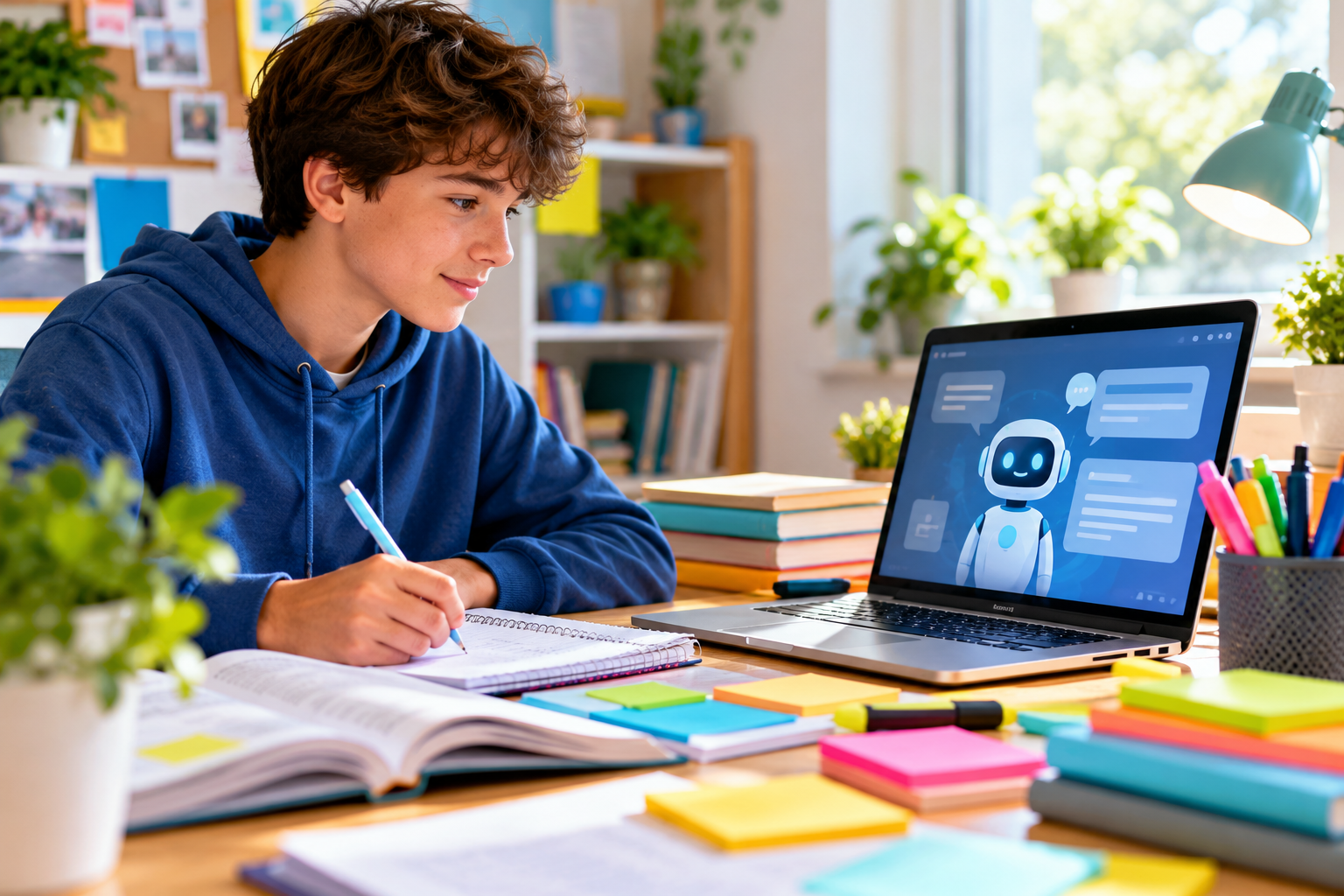
Artificial intelligence is rapidly becoming part of everyday life. From search engines and smartphones to writing assistants and educational platforms, AI is increasingly influencing how we find information, solve problems and learn new skills. For children and teenagers, this raises an important question: should children use AI for homework and revision?
For many parents, the answer is not straightforward. AI tools can explain difficult concepts, generate practice questions, provide feedback and help pupils organise their revision. Used appropriately, they can be genuinely useful learning aids. However, there is also a risk that children begin to rely on AI to complete work for them rather than using it to develop their own knowledge and skills.
The key distinction is therefore not simply whether a child uses AI, but how they use it.
At Bristol Tutors, we believe technology can support education, but it should complement rather than replace independent thinking, effective teaching and meaningful human interaction. In this article, we explore how children can use AI responsibly for homework and revision, where parents may need to set boundaries, and why human support continues to matter.
What Does Using AI for Homework Actually Mean?
When people discuss AI and education, it is easy to imagine a pupil simply entering their homework question into an AI tool and copying the response. While this can happen, it represents only one possible use of the technology.
AI can also function more like an interactive study assistant.
For example, a pupil struggling with algebra could ask an AI tool to explain a particular method in simpler language. A GCSE student could ask it to generate five practice questions on a topic they have recently revised. A child learning new vocabulary might ask for a quiz, while an A-level student could use AI to suggest questions that test their understanding of a topic.
This distinction matters.
There is a considerable difference between asking AI, “Write my homework answer for me” and asking, “Explain this concept and then give me a question so I can try it myself.”
The first approach potentially bypasses learning. The second can actively encourage it.
The Potential Benefits of AI for Homework and Revision
Used thoughtfully, AI can offer children access to additional explanations and practice outside the classroom.
One of its most useful features is its ability to provide information in different ways. A pupil who does not understand an explanation in a textbook may be able to ask for the same concept to be explained more simply, broken into steps or illustrated with an example.
This can be particularly useful during revision. Children do not always need more information; sometimes they need another way of looking at information they have already encountered.
AI can also make revision more interactive. Rather than repeatedly reading notes, a pupil could ask AI to quiz them, create flashcard questions or test them on key terminology. This can encourage active recall, where learners have to retrieve information from memory rather than simply recognising it on a page.
However, pupils should still check important information against reliable sources such as their school materials, textbooks, examination-board specifications or guidance from a teacher or tutor. AI tools can make mistakes and can sometimes produce answers that sound convincing even when they are inaccurate.
The Biggest Risk: AI Doing the Thinking for the Child
Perhaps the greatest concern surrounding AI and homework is that it can make completing a task easier without necessarily making learning easier.
Homework is not simply about producing a finished page of answers. The thinking involved in reaching those answers is often the most valuable part.
A child writing an essay has to decide what they think, select evidence, organise ideas, construct sentences and edit their work. A pupil solving a maths problem has to identify an appropriate method, attempt it, recognise errors and try again.
These processes can be difficult. They are also where learning happens.
If AI performs too much of this work, a child may produce something impressive without developing the skills the task was designed to practise.
This can create a false sense of confidence. A polished homework submission might suggest that a pupil understands a topic well, yet when they encounter a similar question independently in an assessment, they may struggle.
AI and the Illusion of Learning
This is particularly important during revision.
AI can make information feel extremely accessible. If a pupil knows they can instantly ask for an explanation or answer, they may confuse having access to knowledge with actually knowing it.
Reading a clear AI-generated explanation can produce the feeling of understanding. But genuine learning requires the pupil to be able to recall, explain and apply that information independently.
A useful test is simple: once the AI tool has been closed, can the child still explain the idea?
If not, more learning is needed.
One effective approach is to ask AI for an explanation, study it carefully and then put the device aside. The pupil can then explain the concept aloud, write down what they remember or answer a question without assistance.
AI becomes the starting point rather than the finished product.
Good Ways for Children to Use AI for Revision
Parents do not necessarily need to ban AI to prevent over-reliance. In many cases, teaching children how to use it appropriately may be more valuable.
AI can be used productively to:
- explain a difficult idea in simpler language;
- generate practice questions on a specific topic;
- quiz a pupil after they have revised;
- suggest examples that illustrate a concept;
- help create a revision timetable or break a large task into manageable steps;
- provide feedback on an answer the pupil has already attempted;
- ask questions that encourage the pupil to explain their reasoning;
- suggest areas to revisit after a pupil identifies something they do not understand.
The principle behind all of these examples is the same: the child should still be doing the intellectual work.
A helpful rule for families might be: try first, use AI second, check your understanding third.
What About Using AI to Write Essays and Homework?
This is where clearer boundaries may be necessary.
If a child asks an AI tool to generate an entire essay, book review or homework response and then submits it as their own work, the teacher no longer has an accurate picture of what that pupil can do independently. It may also breach the school’s rules on acceptable AI use.
There is another problem too: the child misses the practice.
Writing develops through writing. Mathematical reasoning develops through solving problems. Reading comprehension develops through engaging with texts. These skills cannot be outsourced indefinitely without consequences.
AI may still have a role in supporting written work. For example, after writing their own paragraph, a pupil might ask for feedback on whether their argument is clear. They could then decide which suggestions to accept and rewrite the paragraph themselves.
That keeps the learner in control of the process.
Parents should also encourage children to understand their school’s AI policy. Expectations may differ depending on the school, subject and assignment, and pupils need to know when AI assistance is permitted and when work must be completed entirely independently.
AI for Primary School Children
For younger children, adult supervision is particularly important.
Primary-aged pupils are still developing fundamental literacy, numeracy and reasoning skills. If technology removes too much of the struggle involved in practising these skills, it can become counterproductive.
For example, a child learning multiplication needs opportunities to retrieve number facts independently. A child developing writing skills needs to practise constructing their own sentences. AI should not replace this foundational work.
However, a parent or tutor might use AI behind the scenes to generate a simple quiz, suggest a child-friendly explanation or create additional practice ideas.
At this age, AI may often work best as a tool used alongside an adult, rather than something a child relies upon independently.
AI for Secondary School and GCSE Revision
As pupils become older, they can begin taking more responsibility for how they use AI.
For secondary and GCSE students, AI can be useful for identifying gaps in knowledge and generating additional practice. A student might revise photosynthesis and then ask for ten questions that gradually become more challenging. They could answer without assistance and then compare their responses with explanations.
The danger arises when AI becomes the first destination whenever a question feels difficult.
Examinations still require pupils to work independently. Revision therefore needs to include substantial periods where AI, notes and textbooks are unavailable.
One useful strategy is to separate learning mode from testing mode. AI might be allowed during learning mode to clarify difficult concepts. During testing mode, the pupil answers questions under exam-style conditions without assistance.
AI for A-Level and Older Students
Older students can potentially use AI in more sophisticated ways.
Rather than simply asking for information, they can use it to challenge their thinking. An A-level student might ask AI to present an alternative interpretation of a literary text, challenge an argument they have developed or generate questions that require evaluation rather than simple recall.
Students should nevertheless remain critical.
AI-generated information should not automatically be treated as authoritative. Older pupils need to consider where information comes from, whether claims are supported by reliable evidence and whether an answer actually meets the requirements of their course.
Developing this critical judgement may itself become an increasingly important academic skill.
AI and SEND Learners
AI may offer particular benefits for some children and young people with special educational needs and disabilities (SEND), although its usefulness will depend greatly on the individual learner.
A pupil who finds dense text overwhelming may benefit from an explanation being broken into smaller steps. A learner with difficulties around organisation or executive function might use technology to help structure a revision session or turn a large assignment into smaller tasks.
Some pupils may also appreciate being able to ask for an explanation repeatedly without feeling embarrassed about not understanding it the first time.
However, accessibility should not become dependency.
A child who already struggles with confidence, attention, memory or independent working may be particularly vulnerable to allowing an AI tool to take over difficult parts of a task. Support should therefore focus on helping the learner use technology to increase independence, rather than replacing it.
Parents, teachers and tutors can help by observing whether AI is enabling a pupil to attempt more independently afterwards. If the child becomes progressively more capable without the tool, it is probably supporting learning. If they become increasingly reluctant to attempt anything without it, the balance may need adjusting.
Why Human Tutors Still Matter in an AI World
AI can produce an explanation within seconds, but education involves far more than delivering information.
A good tutor observes how a pupil approaches a question. They notice hesitation, frustration, confidence and misconceptions. They can recognise when a child says they understand but is still uncertain. They can adapt a lesson based on the pupil’s responses and build a relationship that makes it easier for the learner to ask questions.
Human tutors can also provide something technology cannot genuinely replicate: mentorship and accountability.
Sometimes a pupil knows exactly what they should revise but struggles to begin. Sometimes the difficulty is confidence rather than knowledge. Sometimes a child needs encouragement to persevere with a question instead of immediately searching for the answer.
These moments require judgement, empathy and an understanding of the individual learner.
AI can be a useful tool within education. It does not replace the value of a skilled person sitting with a learner, identifying what they need and helping them become increasingly independent.
How Parents Can Set Healthy Boundaries Around AI
Families may find it useful to discuss AI before it becomes a source of disagreement.
Rather than focusing only on screen time, talk about the purpose of using the tool. Ask your child what they are trying to achieve and whether AI is helping them learn or simply helping them finish.
You might ask questions such as, “Can you explain that answer to me without looking at the screen?” or “What did you try before asking AI?”
These questions shift attention away from the finished answer and towards the learning process.
It is also worth creating AI-free opportunities. Practice papers, retrieval exercises, essay planning and other independent activities allow children to see what they can genuinely remember and apply without assistance.
That information is valuable. Getting something wrong during revision is not a failure; it shows the learner what they need to work on next.
So, Should Children Use AI for Homework and Revision?
There is no simple yes-or-no answer.
AI can be an extremely useful educational tool when it helps children understand difficult concepts, practise retrieval, organise revision and receive additional explanations. But it becomes less helpful when it removes the need to think, struggle, remember or create.
The most useful question for parents may therefore be:
Is AI helping my child learn to do this independently, or is it doing it for them?
When AI supports the journey towards independence, it can have a valuable place in learning. When it becomes a substitute for independent thought, its convenience can come at an educational cost.
At Bristol Tutors, we believe effective learning is ultimately about helping pupils become more confident, capable and independent. Technology can contribute to that process, but it works best alongside strong teaching, appropriate challenge, regular practice and meaningful human support.
AI is likely to remain part of children’s educational lives. Helping young people learn how to use it critically and responsibly may therefore be more valuable than simply telling them whether they can or cannot use it.
The aim should not be to raise children who never use AI. It should be to raise learners who know when to use it, when to question it and when to put it away and think for themselves.